- "Scotland, it has often been said, was invented by Walter Scott in his portrayal of its history." - xv
- "There seem to have been three tribes in the Lowlands" during the Roman incursion "the Votadini in the east...the Novantae in the south-west...and in between them the Selgovae" - 15
- 122: Hadrian "consolidate[d] the northern frontier with that great barrier, Hadrian's Wall, across the isthmus between the Solway and the Tyne." - 19
- 139: new Roman Governor Quintus Lollius Urbicus "marches north from the wall in strength to reoccupy the territory Agricola had seized...It was then that he decided to consolidate his gains by building the Antonine Wall." - 19
- "the great 'Barbarian Conspiracy' which, through accident or design, attacked Roman Britannia simultaneously from all sides in 367; the Angles and Saxons overwhelmed the coastal forts of the south and east, the Gaelic-speaking Scoti from Ireland came sweeping in across the Irish Sea, and the Picti overran Hadrian's Wall from the north." - 21
- 638: "Din Eidyn was besieged and captured by the avenging Angles [after a Gododdin attack], and the place seems then to have received the anglicised name Edinburgh." - 26
- 685: "it was the Battle of Dunnichen [with the Picts repelling the Northumbrians] which passed the way for northern Britain eventually to become the independent nation of Scotland and not just a northern extension of England." - 30
- "The power of Dalriada (Scoti) was now in decline and, despite occasional hostility between Scots and Picts, there was a certain inevitability about the way in which the two kingdoms began to come together against the common viking enemy." - 40
- 1018: "the Battle of Carham...marked the first firm delineation of a settled frontier between Scots and English along the line of the River Tweed" - 46
- "in the latter half of the eleventh century, Scotland can be seen to be moving from a Gaelic-speaking realm of semi-autonomous princedoms to a much more centralised monarchy on the English and Continental model. If Macbeth was the last truly Celtic King of Scots, as some claim, it is because during Malcolm [Canmore]'s reign there was a greater intermingling of the Celtic and Anglo-Norman cultures and mores." - 65
- 1237: Alexander II "signed an amicable agreement...whereby he renounced all claim to territory south of the Tweed and the Solway...The Treaty of York...was of extreme historical importance in that it established the Anglo-Scottish frontier...It was an implicit acceptance by England...of Scotland's right to exist as a free and independent kingdom." - 92
- 1266: the Treaty of Perth, King Magnus of Norway agrees to cede control of the Hebrides (Western Isles) and Isle of Man to Alexander III of Scotland; Norway retained the northern islands of Orkney and Shetland - 103
- 1295: the "Treaty of Paris guaranteed that Scotland would maintain hostile pressure on England in return for military aid from France should Scotland be invaded...Effectively, the Treaty of Paris was the start of what have become known as the 'Wars of Independence'" - 119
- 1308: "Apart from the key fortresses of Dundee, Perth and Stirling he [Robert the Bruce] now controlled the old kingdom of Scotia north of the Forth-Clyde line and could justifiably claim to be King of Scots by right of conquest." - 177
- April 6, 1320: "Yet if he [Robert the Bruce] should give up what he has begun, and should seek to make us or our kingdom subject to the King in England or to the English, we would strive at once to drive him out as our enemy and a subverter of his own right and ours, and we would make some other man who was able to defend us our king; for, as long as but a hundred of us remain alive, we shall never on any condition be subjected to English rule." - 188, Declaration of Arbroath
- February 23, 1371: "everything changed: practically on the eve of his wedding to [Black] Agnes [of Dunbar] the king [David II] suddenly died in Edinburgh Castle. After all his machinations and manoeuvrings, the man whom he had tried so hard to prevent inheriting the throne won -- simply by surviving. At the age of fifty-five David's nephew, Robert Stewart, became King Robert II, the first of the long and tragically unlucky royal Stewart dynasty of Scotland." - 208
- 1502: "Treaty of Perpetual Peace...This was a fateful moment in Anglo-Scottish relations...it was eventually to lead to the union of the two crowns exactly a century later, when a great-grandson of the marriage [of James IV and Margaret], James VI of Scotland, became James I of England as well in 1603" - 280
- November 24, 1542: Battle of Solway Moss, "James [V] feinted an assault to the south-east, but at the same time was planning an assault through the Merse in the west...he summoned a muster of his army to meet him at Lauder on 20 November; meanwhile, another force was mustering farther to the west, in Peebles." - 312
- "the Scots feared that Scotland was becoming a mere satellite province of France, and the Reformers now became associated with patriotism and liberty -- they became the party which opposed foreign domination and occupation." - 335
- Andrew "Melville led a committee of thirty Kirk [Scot. Church] ministers who produced the Second Book of Discipline" which "rejected the notion of royal supremacy and insisted on the political autonomy of the General Assembly of the Kirk...In effect, the Kirk claimed to be empowered to direct the secular head of the state in accordance with the will of God. King James [VI], however, was determined to be a 'universal king', which meant a monarch subordinate to no one -- especially not to the Kirk." - 388
- After the Union of the Crowns in 1603, King James VI and I "believed that there would now be an end to conflict between his two countries, and one of his first acts was to stand down the garrisons at Berwick and Carlisle. He wanted the Union of the Crowns to be a full Union of the Kingdom, a single country called Magna Britannia -- Great Britain." - 401
- January 30, 1649: "With a single strike of his axe the masked executioner severed the neck of the king of both kingdoms [, Scotland and England, Charles I]. A 'terrible groan' came from the crowds who witnessed the dignified death of the first monarch in Christendom to be overthrown, tried and judicially executed by his own subjects." - 449
- "The Union of the Crowns had been smashed: Scotland and England were two completely separate nations again -- neighbors bound only by mutual animosity, as they had been for centuries." - 455
- February 1705: Alien Act, "Unless the Scottish parliament appointed commissioners to negotiate...for an Incorporating Union between England and Scotland, severe penalties would be imposed: all non-naturalised Scots living in England would be treated as aliens; all Scottish estates in England would be seized; and all the major Scottish exports to England...would be barred. The Scots were outraged by this economic bludgeon...England had now abandoned its traditional opposition to closer union -- indeed, was insisting upon it." - 543
- "Jacobite propaganda blamed all Scotland's ills on the 1707 Union; the only possible remedy was a return to the glorious pre-Revolution Stewart years of the the seventeenth century." - 579
- November 3, 1745: "the army [under Prince Charles Edward Stuart, the 'Young Pretender'], now numbering five thousand men, left Dalkeith. One column under Tullibardine and the Duke of Perth, bringing the main artillery train, left Edinburgh for Carlisle, marching by Peebles, Moffat and Lockerbie." - 600
Friday, February 15, 2013
Scotland: The Story of a Nation by Magnus Magnusson

Sunday, November 25, 2012
Bismarck by Edward Crankshaw
- "just as his Christianity amounted really to a special relationship with the Almighty, whom he appropriated to his own purposes, so his republicanism was essentially no more than a declaration of the special rights of Otto von Bismarck, which could be overridden only by divine sanction operating through a hereditary monarch." - 14
- "with her illness and death Marie [von Thadden] accomplished what all the magic of her living presence had failed to do. In the shock of desolation Bismarck could no longer accept and live with the meaninglessness of life without God." - 24
- "The man was energy incarnate, but the electricity had nowhere to flow, so it sparked and leapt gaps." - 28
- April 1847: King of Prussia, Frederick William, acceding to liberalization and desperate for funds for a railroad, opened the proceedings of the United Diet - 36
- "we have to consider those long absences from Berlin when he was virtual dictator, buried deep in the country...Many reasons have been offered for this behavior except the obvious one: that from time to time he was flooded with a complex and overpowering need: at one and the same time to get away from people and to assert himself absolutely" - 43
- "what was happening all over the Continent [of Europe in 1848] was the breakup of the system devised by Metternich and imposed by the Congress of Vienna in 1815." - 45-6
- "The only healthy foundation for a large state -- and this is what distinguishes it from a small state -- is state egoism rather than romanticism, and it is unworthy of a great state to fight for something which does not affect its own interest." - Otto von Bismarck, 62
- "Frankfurt, though broadening his vision of Europe, at the same time blinkered it by confining it to diplomatic and manoeuvre. He had no occasion to think about Prussia as a living organism, developing in response to the spirit of the industrial age." - 69
- "Inevitability was a concept he instinctively rejected: the lives of nations as well as individuals were so full of accidents....the greatest service a statesman could do was to keep his mind open to all possibilities." - 71
- "this strange man, who lashed himself into a genuine fury at what he considered Austria's perfidy and selfishness and unreliability (he meant, of course, her antagonism to Prussian expansionism), established himself as the prophet and champion of the self-centred state, concerned only with its own security and growth." - 87
- September 15, 1859: Nationalverein (National Union) launched as an all-German association which "would look to Prussia to champion the cause of German unity in face of Austrian opposition." - 100-1
- "it was against this background of incipient civil war, or at least the destruction of parliament in any form, that Bismarck came to power. He had not only the Liberals to deal with; he had to neutralize the Manteuffels [ie. the militarists] as well" - 115
- Bismarck said to Disraeli, "I shall soon be compelled to undertake the army, with or without the help of the Landtag....As soon as the army shall have been brought to such a condition as to inspire respect, I shall seize the best pretext to declare war on Austria, dissolve the German diet, subdue the minor states, and give national unity to Germany under Prussia's leadership." - 122
- September 30, 1862: Bismarck said, Prussia "must gather together her forces, conserving her strength for the favorable moment which has been missed several times already. Prussia's frontiers as drawn by the Vienna Treaty do not favour a healthy political existence. The great questions of the day will be decided not by speeches and majority votes -- that was the great mistake of 1848 and 1849 -- but by iron and blood." - 133
- "A statesman wise in constitutional matters has said that all constitutional life is always a series of compromises. If compromise is made impossible...the series of compromises is broken and is replaced by conflicts. Since the life of a state cannot stand still, conflicts become questions of power; whoever has the power in his hands then proceeds according to his will." - Otto von Bismarck, 138
- "He had only one idea, the idea summed up by the term Realpolitik, the exaltation of the Staatsrecht, the right and duty of the state to pursue its own advantage regardless of any other consideration and by whatever means comes to hand, coldly excluding morality, decency, honour." - 181
- "At a time when the rest of Europe...was moving towards greater individual freedom...Bismarck was systematically transforming Prussia into a police state...He operated thus with one purpose only -- to subdue the Prussian people for the enlargement and glorification of the Prussian state." - 184-5
- March 1866: "Prussia signed a secret treaty of alliance with Italy with a life of only three months: Italy would fight Austria on Prussia's side if she went to war within those three months." - 201
- "The failure of Austria was a failure of high command; the success of Prussia was a success of the high command." - 210, cf. Helmuth von Moltke the Elder
- "Nothing has contributed more to the legend of Bismarck's statesmanlike moderation than his fight...to keep defeated Austria intact as a future ally." - 218
- "What Bismarck had achieved was mastery of a new middle party, a National Liberal party, from which the extreme right and the extreme left split off." - 228
- "Bismarck and Bucher between them digested this mass of material ['various other federal constitutions'] and produced out of it a constitution [of 1867] that was to serve first the North German Confederation, then the new Reich born out of the Franco-Prussian War, for good or ill until 1918. All in a matter of days." - 232-3
- "Johann Gottlieb Fichte...invented German patriotism, which was really Prussian patriotism, in which the will of the individual, the will of the German people, became identified with the will of the universe, of God." - 237
- "By the time the two great armies moved against each other on 28 July 1870, Bismarck had irretrievably set the German people on the path to the mastery of Europe -- or disaster." - 270
- January 1871: "under extreme provocation from Moltke he demanded from William, and with surprising ease obtained, a categorical statement that he, the prime minister, was to be responsible for all dealings with the French authorities in the matter of the armistice and the ultimate peace-making [after the Franco-Prussian War]; further, that he must be kept fully informed about the course of all future military operations and given the opportunity to express his views." - 288
- "Moltke was concerned with the humiliation of France, and that alone. For Bismarck victory was simply a critical stage on the way to the establishment of a unified imperial Germany with the Prussian king as emperor." - 291
- "in the words of a distinguished British historian [W.N. Medlicott], 'Bismarck is judged to be right because he is the master diplomatist; he is the master diplomatist because he is right.'" - 304
- "Bismarck was not interested in Europe, but only in Prussia, his Prussia: later in Germany, his Germany. He did not want a strong and healthy France as a neighbor. He was obsessed with 'the nightmare of coalitions,' with the perils of war on two fronts..., specifically with the horror of a Germany caught between France and Russia." - 324
- "his main purpose...was to mould Europe into a safe haven in which the new Reich could flourish and extend her influence. Instead he made Germany the most distrusted power in Europe. Having alienated France, he proceeded to alienate first Britain, then Russia" - 336
- "Bismarck was determined to destroy Socialism as he was determined to destroy Liberalism." - 356
- "The defensive treaty with Austria of October 1879 was the first in a period of compulsive diplomatic activity which brought into being the Dual Alliance -- later, with the accession of Italy, to be the Triple Alliance. The climax was the so-called Reinsurance Treaty with Russia, triumphantly signed in June 1887." - 369
- "Bismarckian diplomacy might be defined as secret agreements exacerbated by leaks...That is to say, he allowed others to see that something was going on, but gave them no idea what it was." - 369
- "There were four main considerations in the forefront of his mind once the Three Emperors' League was attained: how to keep as close to Russia as possible and minimize Germany's commitment to Austria; how to secure the friendship of France; how to destroy Socialism once for all; above all, how to weaken the crown prince so that he, Bismarck, would be able to survive the emperor's death." - 394-5
Friday, October 19, 2012
Mont Saint Michel and Chartres by Henry Adams
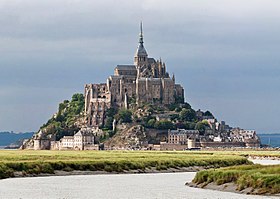 |
| Mont Saint Michel, Normandy, France |
- "The Archangel [Michael] stands for Church and State, and both militant." - Ch. 1 Saint Michiel de la Mer del Peril, 343
- "Church and State, Soul and Body, God and Man, are all one at Mont Saint Michel, and the business of all is to fight, each in his own way, or to stand guard for each other." - 349
- "The great cathedrals after 1200 show economy, and sometimes worse. The world grew cheap, as worlds must." - 350
- "Barring her family quarrels, Europe was a unity then [11th century], in thought, will and object. Christianity was the unit. Mont Saint Michel and Byzantium were near each other...The East was the common enemy, always superior in wealth and numbers, frequently in energy, and sometimes in thought and art." - Ch. 3 The Merveille, 371
- "History is only a catalogue of the forgotten. The eleventh century is no worse off than its neighbors. The twelfth is, in architecture, rather better off than the nineteenth." - 373
- "To overload the memory with dates is the vice of every schoolmaster and the passion of every second-rate scholar." - 374
- "Saint Francis was preaching to the birds in 1215 in Assissi, and the architect built this cloister [the Merveille] in 1226 at Mont Saint Michel. Both sermons were saturated with the feeling of the time, and both are about equally worth noting, if one aspires to feel the art." - 382
- "the Norman will be the practical scheme which states the facts, and stops; while the French will be the graceful one, which states the beauties and more or less fits the facts to suit them. Both styles are great: both can sometimes be tiresome." - Ch. 4 Normandy and the Ile de France, 392
- "In the western church the Virgin had always been highly honored, but it was not until the crusades that she began to overshadow the Trinity itself." - Ch. 6 The Virgin of Chartres, 427
- "Chartres represents, not the Trinity, but the identity of the Mother and Son. The Son represents the Trinity, which is thus absorbed in the Mother." - 436
- "The world still struggles for unity, but by different methods, weapons and thought." - Ch. 8 The Twelfth Century Glass, 470
- "Mary's taste was infallible; her knowledge like her power had no limits; she knew men's thoughts as well as acts, and could not be deceives...in the twelfth century the gallows was a trifle; the Queen hardly considered it a punishment for an offence to her dignity. The artist was vividly aware that Mary disposed of Hell." - Ch. 9 The Legendary Windows, 490
- "the sermon of Chartres...teaches and preaches and insists and reiterates and hammers into our torpid minds the moral that the art of the Virgin was not that of her artists but her own. We inevitably think of our tastes; they thought instinctively of hers." - Ch. 10 The Court of the Queen of Heaven, 519
- "The docile obedience of the man to the woman seemed as reasonable to the thirteenth century as the devotion of the woman to the man, not because she loved him, for there was no question of love, but because he was her man, and she owned him as though he were her child." - Ch. 11 The Three Queens, 533
- "it is the art we have chased through this French forest...and the art leads always to the woman." - Ch.12 Nicolette and Marion, 568
- "If a Unity exists, in which and towards which all energies centre, it must explain and include Duality, Diversity, Infinity, -- Sex!" - Ch. 13 Les Miracles de Notre Dame, 582-3
- "The People loved Mary because she tramples on conventions; not merely because she could do it, but because she liked to do what shocked every well-regulated authority." - 585
- "Mary concentrated in herself the whole rebellion of man against fate; the whole protest against divine law; the whole contempt for human law as its outcome; the whole unutterable fury of human nature beating itself against the walls of its prisonhouse" - 596
- "Army, Church, and State, each is an organic whole, complex beyond all possible addition of units, and not a Concept at all, but rather an animal that thinks, creates, devours and destroys." - Ch. 14 Abelard, 621
- "For several thousand years mankind has stared Infinity in the face without pretending to be the wiser; the pretention of Abelard was that, by his dialectic method, he could explain the Infinite, while all other theologists talked mere words" - 632
- "The [Church's] battle with the schools had then resulted only in creating three kinds of sceptics: the disbelievers in human reason; the passive agnostics; and the sceptics proper who would have been atheists had they dared." - Ch. 15 The Mystics, 639
- "If ever modern science achieves the definition of Energy, possibly it may borrow the figure: -- Energy is the inherent effort of every multiplicity to become unity." - 649
- "The charm of the twelfth-century Church was that it knew how to be illogical...when God himself became illogical." - 656
- "God is an intelligent, fixed Prime Motor, -- not a concept, or proved by concepts; -- a concrete fact, proved by the senses of sight and touch. On that foundation Thomas built." - Ch. 16 Saint Thomas Aquinas, 668-9
- "The whole universe is, so to speak, a simple emanation from God. The famous junction, then, is made! that celebrated fusion of the Universal with the Individual, of Unity and Multiplicity, of God and Nature, which had broken the neck of every philosophy ever invented" - 674
- "Theist or atheist, monist or anarchist must all admit that society and science are equally interested with theology in deciding whether the Universe is one or many, a harmony or a discord. The Church and State asserted that it was a harmony and that they were its representatives." - 682
Democracy, Esther, Mont Saint Michel and Chartres, The Education of Henry Adams by Henry Adams, Library of America, 1983.
Saturday, September 8, 2012
The Two Gentlemen of Verona by William Shakespeare
Characters
- Duke of Milan: Silvia's father
- Valentine: Gentleman of Verona
- Proteus: Gentleman of Verona
- Antonio: Proteus' father
- Thurio: foolish rival to Valentine
- Eglamour: Agent for Silvia in escape
- Host: where Julia lodges
- Outlaws: with Valentine
- Speed: a clownish servant to Valentine
- Launce: a clownish servant to Proteus
- Panthino: Servant to Antonio
- Julia: beloved of Proteus
- Silvia: beloved of Valentine
- Lucetta: waiting-woman to Julia
- After receiving no response from Julia to his letter of love, Proteus follows his friend Valentine to Milan and decides to begin pursuing the current love interest of Valentine, Silvia. By informing the Duke of Valentine's plan to run off with the Duke's daughter Silvia, Valentine is banished to Mantua, and Proteus continues in his pursuit. His abandoned love interest, Julia gets in close to the intrigue by dressing herself as a boy and delivering a message to Silvia and observing the results.
- Proteus. He [Valentine] after honour hunts, I after love: he leaves his friends to dignify them more; I leave myself, my friends and all, for love. (1.1)
- Proteus is sent by his father Antonio to serve in the emperor's court alongside Valentine, just as the relationship between Proteus and Julia is budding. (1.3)
- Proteus. O, how this spring of love resembleth the uncertain glory of an April day, which now shows all the beauty of the sun, and by and by a cloud takes all away. (1.3)
- Speed. If you lover here [Silvia], you cannot see her.
- Valentine. Why?
- Speed. Because Love is blind. (2.1)
- Proteus. I will forget that Julia is alive, remembering that my love to her is dead; and Valentine I'll hold an enemy, aiming at Silvia as a sweeter friend. (2.6).
- in regards to winning the heart of a 'lady of Verona',
- Duke. She did scorn a present that I sent her.
- Valentine. A woman sometimes scorns what best contents her. (3.1)
- First Outlaw. [on the frontiers of Mantua, between Milan and Verona]...you [Valentine] are beautified with goodly shape and by your own report a linguist and a man of such perfection as we do in our quality much want --
- Second Out. ...Are you content to be our general? To make a virtue of necessity and live, as we do, in this wilderness?...
- Valentine. I take your offer and will live with you, provided that you do no outrages on silly women or poor passengers.
- Third Out. No, we detest such vile base practices.
- Thurio. How likes she [Silvia] my discourse?
- Proteus. Ill, when you talk of war.
- Thurio. But well, when I discourse of love and peace?
- Julia. [In disguise; Aside] But better, indeed, when you hold your peace.
- Thurio. What says she to my valor?
- Proteus. O, sir, she makes no doubt of that.
- Julia. [Aside] She needs not, when she knows it cowardice.
- Thurio. What says she to my birth?
- Proteus. That you are well derived.
- Julia. [Aside] True; from a gentleman to a fool.
- Thurio. Considers she my possessions?
- Proteus. O, ay; and pities them.
- Thurio. Wherefore?
- Julia. [Aside] That such an ass should owe them.
- Proteus. That they are out by lease.
Friday, September 7, 2012
The Tempest by William Shakespeare
Characters
- Alonso: King of Naples
- Sebastian: Alonso's brother
- Prospero: the right Duke of Milan
- Antonio: Prospero's brother, the usurping Duke of Milan
- Ferdinand: Alonso's son
- Gonzalo: honest old Counsellor
- Adrian: Lord
- Francisco: Lord
- Caliban: savage and deformed Slave
- Trinculo: Jester
- Stephano: drunken Butler
- Miranda: Prospero's daughter
- Ariel: airy Spirit, among others (Iris, Ceres, Juno, etc.)
- As the King of Naples and his crew return home from the wedding of his daughter in Tunis, they are shipwrecked on an island by a spirit commanded by the Duke of Milan. The Duke has been on the island for 12 years along with his daughter, and his brother, the usurping Duke of Milan, washes ashore with the other members of the King's entourage. There is love. There is forgiveness.
Notes/Quotes
- Antonio [usurping Duke]. Let's all sink with the king.
- Sebastian [King's brother]. Let's take leave of him. (1.1)
- Prospero has been in an island gaol for 12 years (1.2)
- Miranda [Prospero's daughter]. I should sin to think but nobly of my grandmother: good wombs have borne bad sons. (1.2)
- Prospero enlisted Ariel's help in crashing the boat with the King's and his entourage and dispersing them safely on the island in exchange for the spirit's liberty (1.2)
- Sebastian. Thy case, dear friend, shall be my precedent; as thou got'st Milan, I'll come by Naples. Draw thy sword: one stroke shall free thee from the tribute which thou payest; and I the king shall love thee.
- Antonio. Draw together; and when I rear my hand, do you the like, to fall it on Gonzalo. (2.1)
- Trinculo [Jester]. Swum ashore, man, like a duck: I can swim like a duck, I'll be sworn. (2.2)
- Enter Prospero above, invisible. Enter several strange Shapes, bringing in a banquet; they dance about it with gently actions of salutation; and, inviting the King, et cetera, to eat, they depart (3.3)
- Ariel. But remember -- for that's my business to you -- that you three from Milan did supplant good Prospero; exposed unto the sea, which hath requit it, him and his innocent child: for which foul deed the powers, delaying, not forgetting, have incensed the seas and shores, yea, all the creatures, against your peace. (3.3)
- Miranda. These our actors, as I foretold you, were all spirits and are melted into air, into thin air: and, like the baseless fabric of this vision, the cloud-capp'd towers, the gorgeous palaces, the solemn temples, the great globe itself, yea, all which it inherit, shall dissolve and, like this insubstantial pageant faded, leave not a rack behind. We are such stuff as dreams are made on, and our little life is rounded with sleep. [emphasis mine] (4.1)
Sunday, August 19, 2012
Growth Fetish by Clive Hamilton
- Growth Fetishism
- The Growth Fetish - Ch. 1
- "In the thrall of the growth fetish, all the major political parties in the West have made themselves captives of the national accounts." - 2
- "Cargo cults and the growth fetish both invest magical powers in the properties of material goods, possession of which is believed to provide for a paradise on earth....each has prophets whose role is to persuade ordinary people to keep the faith, to believe that more cargo or more money will arrive and will take believers to a plane of ecstasy." - 4
- Economists on Wellbeing - Ch. 2
- John Stuart Mill, "the best state for human nature is that in which, while no one is poor, no one desires to be richer, nor has any reason to fear being thrust back by the efforts of others to push themselves forward." - 9
- fore neoliberal economists, "wellbeing is produced by pouring goods and services into a receptacle marked 'human being' -- as if people were production processes that convert commodities into happiness." - 12-13
- The Great Contradiction - Ch. 3
- "Americans believe that the value system that dominates their society is wrong" - 14
- "Americans believe that materialism has overtaken society, with dire consequences" - 14
- "Americans are ambivalent about the contradiction they face. They can see that materialism is corroding the society and themselves, but they are too fearful to change their behaviour in any significant way." - 14
- "Americans understand, albeit somewhat vaguely, that rampant consumerism is destroying the natural environment." - 15
- Political Implications - Ch. 4
- "The individual is not the citizen but the consumer, and for the consumer to be powerful everything must be brought into the realm of the market." - 17
- "Social democracy is being superseded by a sort of market totalitarianism." - 21
- Growth and Wellbeing
- Income - Ch. 5
- "with respect to income, people judge their wellbeing not by the absolute amount of their income but by its relative level." - 27-28
- "more income does make a difference to people who are very poor and lack the basics of food, shelter and health care. But this does not change the fundamental observation that in rich countries increasing income through more economic growth does not improve levels of national wellbeing." - 33
- Personal Happiness - Ch. 6
- "the more our media, advertisers and opinion makers emphasise financial success as the chief means to happiness the more they promote social pathologies." - 40
- "psychiatric disorders are frequently misdiagnosed and improperly treated as physical disorders because of the general social fixation on correcting deviations from a happy ideal rather than acknowledging widespread social distress." - 41
- Values and Meaning - Ch. 7
- "The purpose of life is not to be happy; it is to understand ourselves so that we can achieve personal integration or reconciliation with our selves. It is a process rather than a final state." - 48
- Karl Marx, "The bourgeoisie...has politically torn asunder the motley feudal ties that bound man to his 'natural superiors', and has left remaining no other nexus between man and man than naked self-interest, than callous 'cash payment'." - 52-53
- Alternative Measures - Ch. 8
- Genuine Progress Indicator (GPI): "incorporates a range of factors that influence wellbeing and aggregates them into a single index that can be compared directly over time with GDP." - 55
- "The economy spits out what it does not need -- redundant workers, toxic wastes -- and by this act they no longer appear in the national accounts...The economy values only what it needs; what it does not need has no value." - 60-61
- Identity
- Having and Wanting - Ch. 9
- "margin of discontent" (cf. Mishan) - difference between what you want and have; discontentment can be reduced by either increasing possessions or decreasing desires - 62
- "One of the ironies of the modern world is that choice has been elevated to supreme status precisely at a time of social and cultural homogenisation across the globe." - 66
- Consumption and the Modern Self - Ch. 10
- "in consumer society people attempt to create an identity not from what they produce but from what they consume." - 70
- "as the sociologist George Simmel told us many years ago, the individuality of modern urban life is a pseudo-individuality of exaggerated behaviours and contrived attitudes." - 71-72
- "We are subtly schooled to feel that to possess is to capture power; indeed, that possessions are the source of power in our society." - 75
- Marketing - Ch. 11
- "in reality economic growth can be sustained only as long as people remain discontented. Economic growth does not create happiness: unhappiness sustains economic growth." - 80
- "The expense associated with creating and sustaining a brand, including advertising and sponsorships, explains the cavernous gap between what it costs to actually manufacture a pair or shoes, for example, and the price the consumer pays." - 86
- Overconsumption - Ch. 12
- "Both the pharmaceutical and the food industries profit from obesity and, once again, the medical profession and drug companies play a crucial role in diverting us from asking what it is about our society that gives rise to these pathologies." - 94
- "There is...an intimate relationship between the creation of self in consumer capitalism and the destruction of the natural world. This is the unbridgeable gulf between the 'sustainability' that politicians and business people talk about and the deep ecology of the environmentalists." - 97
- Progress
- The Idea of Progress - Ch. 13
- "In developing the idea of progress, the intention was to find the impersonal laws that explained the sweep of human history." - 99
- Francis Fukuyama, "Technology makes possible the limitless accumulation of wealth, and thus the satisfaction of an ever-expanding set of human desires" - 103
- Oppression and Liberation - Ch. 14
- "Conservative resistance to the demand for self-determination conflates the pursuit of self-determination (individualisation) with the pursuit of selfish interests (individualism)." - 104-105
- "The democratic impulse -- which to date has taken the form of collective struggles to be free of autocrats, plutocrats and oligarchs -- has segued into something else, a search for authentic identity, for self-actualisation." - 106
- "the counter-culture was never a revolt against capitalism: it was a revolt against the social conservatism that held capitalism back." - 111
- Globalisation - Ch. 15
- "it is the spread of political ideas backed by economic power." - 118
- "while many nations achieve political independence after the Second World War, their leaders had absorbed the most intoxicating idea of their colonisers, the belief that the first objective of any state should be economic growth." - 119
- Politics
- The Third Way - Ch. 16
- "a means of grafting traditional social democratic concern for equality and social justice onto an economic system based on free markets." - 122
- "Nowhere in the writings of the Third Way can one find an analysis of how social structures condition thinking; nor can one find discussion of class consciousness or false consciousness or any inkling of why people believe what they do. The political superficiality of the Third Way is the ideal counterpart of the emptiness of modern consumer capitalism." - 130
- The Power of Economic Ideas - Ch. 17
- 1995: "US economists David Card and Alan Krueger created a sensation by showing that employment growth was higher in those US states that had rising minimum wages." - 136
- Power and Equality - Ch. 18
- "equality of opportunity can never be enough if an unacceptable level of inequality is built into the very structure of the capitalist economy." - 140
- "social justice has become individualised and divorced from the essential structure of capitalism at a time when capitalism has reached its most purified form." - 141-142
- Work
- Rethinking Work - Ch. 19
- "The arrival of the age of abundance for the first time provides the possibility of the liberation of work." - 151
- "in a post-scarcity world work can be liberated from the bonds of wage and salary payment, so that it can be considered a creative self-realising activity." - 153
- The New Labour Market - Ch. 20
- "purposeful work, rather than paid employment, provides the rewards people most crave." - 157
- "Abandoning the idea of a career is in fact a process of self-liberation, an act of taking control of your life. In a post-scarcity society, one can fail in one's career but succeed as a man or woman." - 164
- In Praise of Housework - Ch. 21
- "Because housework contributes to a warm, loving and nurturing home environment, we are mistaken to think of it merely as an activity that produces 'household goods and services'." - 167
- "The commodification of household work brings the value system of neoliberal economics into the realm where homo economicus is least welcome." - 169
- Work in a Post-Growth World - Ch. 22
- "An essential feature of a post-growth society, perhaps its defining feature, is the dissolution of the boundary between 'work' and 'life', so that work becomes life." - 171
- "It is the cultural rather than the economic power of capital that convinces them they must work longer and harder: they do so because of their belief about how much income they need in order to maintain an acceptable lifestyle and because income and job status remain central to social status. In other worlds, people have become habituated to high levels of income to sustain their sense of worth." - 173
- Environment
- The Voraciousness of Growth - Ch. 23
- The Conquering Spirit - Ch. 24
- Ecological Footprint: "for each person is defined as 'the biologically productive areas necessary to continually provide their resource supplies and absorb their wastes"; US - 10.3 hectares, UK - 5.2 hectares, Japan - 4.3 hectares, Germany - 5.3 hectares, China - 1.2 hectares, India - 0.8 hectares (Ecological Footprints of Nations, Wackernagel, 1997)
- "Commercial opportunity is the handmaiden of the conquering spirit latterly expressed in the invasion of space. Private sector investment in space-related activities is expanding enormously and is already giving rise to intense pressure for unfettered access to space for commercial purposes." - 189
- A Philosophical Transition - Ch. 25
- Instrumental Value Theory: "while humans are valuable in and of themselves, the non-human world is valuable only insofar as it contributes to the wellbeing of humans." - 191
- Instrumentalist attitudes to Nature
- "the environment is valuable to humans because physical resources provide economic value." - 192
- "preoccupied with the physical transformation of resources but recognises the physical limits to material growth." - 192
- "instrumental value can be had from preserving rather than exploiting some aspects of the natural environment." - 193
- Intrinsic Value Theory: "Environmentalism begins from an intuitive rejection of all instrumentalist approaches...the value of the environment is not dependent on humans attaching value to it, and certainly not on humans deciding whether it contributes to their economic welfare." - 194
- "the marketplace is intensely impersonal, a place where actions are motivated by self-interested calculation between distinct individuals. It allows the full expression of instrumentalist desire." - 196
- Environmentalism and Social Democracy - Ch. 26
- "Proposals that would see higher taxes on environmentally damaging activities, with the revenue used to reduce taxes on employment and investment, are known under the rubric of ecological tax reform." - 200
- Environmental Koznets Curve: "as poor countries industrialise environmental quality will initially deteriorate but as they become richer they will express a greater 'preference' for environmental quality" - 202
- The Post-Growth Society
- Political Downshifting - Ch. 27
- Eudemonism: The Politics of Happiness - Ch. 28
- "It reaffirms a necessary role for public ownership, but it does not propose any expropriation of private property. It is, however, anti-capitalist in the sense that it argues that society and governments should no longer cede special significance to the objectives or moral claims of the owners of capital." - 212-213
- "the function of the government will be reoriented so that it provides sustenance to life-affirming activities outside the market." - 215-216
- Starting the Transition - Ch. 29
- "Reduction of working hours is the core demand for the transition to a post-growth society." - 218
- "The transition to a post-growth society would begin by imposing restrictions on the quantity and nature of marketing messages" - 219
- "Short-term speculative capital movements should be severely penalised by an international transactions tax." - 220
- "A recasting of tax systems...would supply the revenue for a basic income to be provided unconditionally to all citizens." - 222
- The Post-Growth Economy - Ch. 30
- J. M. Keynes, "for the first time since his creation man will be faces with his real, his permanent problem -- how to use his freedom from pressing economic cares, how to occupy the leisure, which science and compound interest will have won for him, to live wisely and agreeably and well" - 225
- "In the longer term, stabilising population size will reduce the pressure to create new jobs each year so as to absorb new entrants to the labour market." - 228
- "It is erroneous to believe that humans became creative only in response to financial incentives." - 232
- Power and Social Structures - Ch. 31
- "The deprivation model is simply the obverse of the growth model; they are both preoccupied with more income." - 233
- "Whatever the merits of the trickle-down theory in poor countries, it certainly stops working beyond a certain point in rich countries." - 235
- "Whereas Marxism called for the power of capital to be destroyed, eudemonism calls for it be ignored." - 237
Sunday, July 15, 2012
The Decline and Fall of the British Empire: 1781 - 1997 by Piers Brendon
- "By the end of the [18th] century two tons of Caribbean sugar cost the life of one slave. Each sweet teaspoonful dissolved was a bitter portion of African existence, each white grain spilled was a measure of black mortality." - 17
- "A bellicose Britain, employing its time-honored strategy of encouraging allies to fight on the Continent while using naval power to defeat France overseas, stamped its mark or raised its flag all around the globe...Where there had been twenty-three British colonies in 1792, there were forty-three in 1816." - 30
- 1784: "Pitt's India Act...took political control away from John Company [ie. East India Company] and vested it in the British Government." - 37-8
- "Taxation, which raised 18 million pounds a year at this time (a third of the peacetime revenue of Britain itself), was much more important than trade. Indeed, before John Company lost its commercial monopoly in 1813, India was said to be about as valuable a trading partner to Britain as Jersey, though the Company was on the way to creating what has been called the world's first 'narco-military' empire." - 57
- "India was the most imperial element in John Bull's haphazard miscellany of overseas dominions, an empire within an empire." - 58
- 1819: Sir Stamford "Raffles concluded that the only way to prevent the Dutch from regaining their old supremacy was to acquire Singapore...Raffles had a vision that the little fishing village could become the crossroads of Asia, commanding the sea lanes between Europe and the Far East and opening up trade on an unparalleled scale." - 60
- "In short, the intruders began to assault the environment and to turn the Aboriginal world upside down. Nothing corrupted 'savages' more efficiently than 'civilisation'." - 67
- 1867: "the federation of Ontario, Quebec, New Brunswick and Nova Scotia...(other provinces joined later) did little, if anything, to bolster Canada's defences...Anxious not to provoke the Great Republic [of the United States], the sceptr'd isle rejected the term 'Kingdom' of Canada in favour of 'Dominion' - the first of its kind." - 85-6
- "the Maoris [of New Zealand]...quickly acquired literacy from the Scriptures. Perhaps they regarded the Bible as a talisman, though in subsequent wars they used its pages for gun-wadding, asking the missionaries for fresh supplies. But the New Testament, translated during the 1830s, was also their first recorded literature." - 91
- "Power and wealth were the warp and woof of empire. But the worldwide mesh was so loose that if any strand broke, Britons often though, the whole fabric might unravel. Consequently empire-builders were always inclined to advance." - 99-100
- "the seizure of Sing was part of a dialectical process often (though not invariably) repeated throughout imperial history: a defeat at the hands of 'natives' would provoke a belligerent British response, which in turn sowed the seeds of further discord and ultimate alienation." - 118
- Ireland "was England's first real colony...invaded by Henry II, subjugated by Henry VIII, 'settled' by Elizabeth, 'planted' by James I, ravaged by Cromwell and crushed by William of Orange." - 119
- 1798: "a radical peasant uprising took place in Ireland, with French backing. Pitt's remedy was brutal repression followed by attempted assimilation: the Act of Union (1800) incorporated Ireland into the United Kingdom of Britain." - 119
- 1868: "General Sir Robert Napier [conqueror of the Sind]...was sent to invade Ethiopia. The purpose of his expedition was to rescue some sixty European prisoners incarcerated by the Emperor Theodore. But it was also a parade of power." - 159
- Rudyard Kipling on Egypt under Sir Evelyn Baring as Consul-General, "Here is a country which is not a country but a longish strip of market-garden, nominally in charge of a government which is not a government by the disconnected satrapy of a half-dead [Ottoman] empire, controlled pecksniffingly by a Power which is not a Power but an Agency." - 179
- Cecil "Rhodes read Gibbon rather than the Bible. Secretly he even paid impoverished scholars to translate all the original authorities which the historian had used, collecting them in two hundred morocco-bound volumes, with supplementary biographies of the Roman emperors. Rhodes believed that he himself resembled Titus physically, Hadrian intellectually. His favorite quotation was 'Remember always that you are a Roman.'" - 193-4
- "Rhodes, who became Prime Minister of the Cape in 1890, now aimed to form a huge political confederation, a British union of South Africa stretching from the Cape to the Belgium Congo." - 195-6
- Lord Salisbury, former Prime Minister, "saw the partition of Africa as a means of keeping the peace in Europe. And since no major war took place between 1870 and 1914, it is arguable that his policy succeeded, that national animosities were diverted into imperial channels, that European poisons drained away in the swamps, sands and jungles of tropical Africa." - 198
- "Nazi Germany justified its own concentration camps as being a British invention [during the Boer War]. The South African camps left an indelible legacy of bitterness. They filled Afrikaner nationalism with hate as the Great Trek filled it with pride." - 230
- "Liberal policy towards India before the First World War is therefore best summed up in a tripartite formula: repression, concession, procession." - 249
- Even after the completion of the Canadian Pacific Railroad in 1885, "confederation was anything but complete. Regional differences were acute and not until 1949 did Newfoundland, Britain's oldest colony, become Canada's last province." - 285
- "The trouble was not that, whenever Gladstone found an answer to the Irish question, the Irish changed the question. The trouble was that the Irish question always remained the same -- how to get rid of the Union?" - 295
- "Michael Collins, who had evaded capture, favoured rifles over hurleys. Violent resistance was the only alternative, he declared, to remaining 'a vassal state of John Bull.' So while on the run he organised Volunteers into what by mid-1919 became, with the initial connivance and the subsequent support of Sinn Fein, the Irish Republican Army (IRA)." - 311
- "Lloyd and two successors, Sir Percy Loraine and Sir Miles Lampson, were adept at playing the King (as Fuad became in 1922), the Wafd ['a political party...dedicated to breaking the imperial bond' and led by Zaghlul] and the sectional parties against one another." - 331
- 1926: "Balfour bound the dominions to the mother country with a final piece of verbal gossamer: they became 'autonomous communities within the British Empire, equal in status...and freely associated as members of the British Commonwealth of Nations.'" - 334
- "The High Range Club...cherished 'a tradition of members willfully breaking glasses,' smashing furniture and destroying billiard tables. An entertainment at the Screechers Club...was the 'Prang Concerto' which concluded with 'the complete demolition of the piano.' Such behaviour was unlikely to convince colonial people that they were governed by a superior race." - 352
- "The British regarded the Masai as the Spartans of East Africa and did their best to conciliate and recruit them, even when they stole telegraph wire to adorn their women." - 357
- "Settler colonies, Kenya being a prime example, were ripped open for such wealth as they contained. They were...a happy hunting-ground of the adventurer, the gold-digger, the industrial or commercial brigand....The Sudan, which Kitchener had rescued from chaos, rapine, famine and misery of the Khalifate at the battle of Omdurman, was by 1930 a model of good order." - 367-8
- 1935: "Government of India Act. This separated Burma from India and gave the eleven Indian provinces self-rule" - 393
- 1943: "Acts of God caused the dearth of food in India but mammon created the Bengal famine...Instead of procuring food themselves, the authorities advised people to keep two months' stock, which encouraged hoarding, increased prices and produced a 'psychosis of shortage.'" - 403-4
- August 14, 1947: Indian independence from Britain - 413
- January 4, 1948: Burma (Myanmar) gains self-rule and becomes an independent republic - 443
- "Britain itself had only just given all adults the vote and in 1931 Ceylon [Sri Lanka] became the first Asian and colonial nation to do the same." - 451
- February 4, 1948: Ceylon gains self-rule - 454
- the British "scheme was to establish a Malayan Union with the long-term aim that the united states (plus Malacca and Penang but not Singapore, which would become a crown colony and a free port) should evolve into a Southeast Asian dominion." - 457
- "London took responsibility for the defence of Malaya and then Malaysia -- the confederation of former colonies, Malaya, Singapore, Sarawak and North Borneo (Sabah), created in the early 1960s." - 465
- 1945: "Winston Churchill advocated a 'United States of Europe' whereby the Continent would be conjoined 'in a manner never known since the fall of the Roman Empire'" - 466
- "The arguments for quitting India and Burma equally supported a British withdrawal from Palestine. Disengagement there was even more desirable since Palestine divided Britain from America when they needed unity against Russia at the start of the Cold War." - 483
- "After Suez and with American help, it kept the weakened Baghdad Pact in being under another name, the Central Treaty Organisation. It retained influence in Iraq and Libya until their nationalist coups in 1958 and 1969 respectively...Until financial and anti-imperial pressures combined between 1968 and 1971, Britain dominated feudal sheikhdoms on the fringe of the Arabian peninsula, themselves once gatekeepers to the Indian jewel, now guardians of the Gulf's black gold." - 505-6
- "The old concepts of Empire, of conquest, domination and exploitation are fast dying in an awakening world. Among the colonial peoples, there is a vast untapped reservoir of peace and goodwill towards Britain, would she but divest herself of the outmoded, moth-eaten trappings of two centuries ago, and present herself to her colonial peoples in a new and shining vestment...and give us a guiding hand in working our own destinies" - Kwame Nkrumah, "Redeemer" of Ghana, 529
- December 1960: "The combined animus [against imperial systems] was reflected in the United Nations, which...passed its momentous Resolution (No. 1514) demanding 'a speedy and unconditional end to colonialism.'" - 545
- "Throughout their imperial history the British always paid lip service to legality, but by the mid-1950s it was an open secret that Kenya had become a police state that dispensed racist terror. After all Dr. Malan, the Nationalist Prime Minister of South Africa, took it as a model for his apartheid regime." - 566
- after Zimbabwe achieved majority rule and independence on April 17, 1980, Margaret Thatcher said, "The poor Queen...Do you realise the number of colonies that have been handed over from the British Empire since she came to the Throne?"; "The Iron Lady wept." - 604
- "Between 1945 and 1965 the number of people under British colonial rule shrank from seven hundred million to five million." - 605
- 1878: "the Ottoman Empire ceded control of Cyprus to the British Empire....The island was a gratuity acquired by Disraeli for supporting Sultan Abdul Hamid 'the Damned' against Tsar Alexander II" - 617
- Hong Kong "could never hope to become an independent sovereign state, let alone a member of the Commonwealth. Instead it would revert to China as a Special Administrative Region. The transfer of power might be postponed but it could not be avoided, especially when Britain's ninety-nine-year lease on the New Territories surrounding the crown colony expired in 1997." - 642
Saturday, June 23, 2012
Baha'i World Faith: Selected Writings of Baha'u'llah and Abdu'l-Baha
- "Every discerning observer will recognize in the Dispensation of the Qur'an both the Book and the Cause of Jesus were confirmed. As to the matter of names, Muhammad, Himself, declared: 'I am Jesus.'" - Why the People Have Denied God, 15
- "The Bearers of the Truth of God are made manifest unto the peoples of the earth as the Exponents of a new Cause and the Revealers of a new Message. Inasmuch as these Birds of the celestial Throne are all sent down from the heaven of the Will of God...they, therefore, are regarded as one soul and the same person." - Oneness of the Prophets, 21-2
- "Beware, O believers in the Unity of God, lest ye be tempted to make any distinctions between any of the Manifestations of His Cause, or to discriminate against the signs that have accompanied and proclaimed their Revelation. This indeed is the true meaning of Divine Unity" - The Meaning of True Unity, 27
- "Every age hath its own problem, and every soul its particular aspiration. The remedy the world needeth in its present-day afflictions can never be the same as that which a subsequent age may require." - The Remedy the World Needeth, 36
- "That which the Lord hath ordained as the sovereign remedy and mightiest instrument for the healing of all the world is the union of all its people in one universal Cause, one common Faith." - Tablets to the Kings, 58
- "the world is like the vapor in a desert, which the thirsty dreameth to be water and striveth after it with all his might, until when he cometh unto it, he findeth it to be mere illusion." - Tablet to the People, 68
- "All men have been created to carry forward an ever-advancing civilization. The Almighty beareth Me witness: To act like the beasts of the field is unworthy of man." - An Ever-Advancing Civilization, 114
- "Forget your own selves, and turn your eyes towards your neighbor. Bend your energies to whatever may foster the education of men." - The Flood of Grace, 126
- "Liberty causeth man to overstep the bounds of propriety, and to infringe on the dignity of his station." - True Liberty, 137
- "O Son of Man! Should prosperity befall thee, rejoice not, and should abasement come upon thee, grieve not, for both shall pass away and be no more." - The Hidden Words, 162
- "Languages must be reduced to one, and that one language must be taught in all the schools of the world." - Tablet of the World, 176
- "Although a republican form of government profits all the people of the world, yet the majesty of kingship is one of the signs of God. We do not wish that the countries of the world should be deprived thereof. If statesmen combine the two into one form, their reward will be great before God." - The Glad-Tidings, 196
- "Glory is not his who loves his own country, but glory is his who loves his kind." - The Sixth Ishraq, 199
- "This is the century of new and universal nationhood. Sciences have advanced, industries have progressed, politics have been reformed, liberty has been proclaimed, justice is awakening. This is the century of motion, divine stimulus and accomplishment; the century of human solidarity and altruistic service; the century of Universal Peace and the reality of the divine kingdom." - Religion is Progressive, 228
- "If religious beliefs and opinions are found contrary to the standards of science they are mere superstitions and imaginations" - Man and Nature, 240
- "As the rich man enjoys his life surrounded by ease and luxuries, so the poor man must likewise have a home and be provided with sustenance and comforts commensurate with his needs." - Man and Nature, 240
- "A universal or international House of Justice shall also be organized...This international House of Justice shall be appointed and organized from the Houses of Justice of the whole world, and all the world shall come under its administration." - Teachings of Baha'u'llah, 248
- "The immortality of the spirit is mentioned in the Holy Books; it is the fundamental basis of the divine religions." - The Immortality of the Spirit, 323
Thursday, June 14, 2012
Debt: The First 5,000 Years by David Graeber
- "Arguments about who really owes what to whom have played a central role in shaping our basic vocabulary of right and wrong." - 8
- "it begins to be clear why there are no societies based on barter. Such a society could only be one in which everybody was an inch away from everybody else's throat; but nonetheless hovering there, poised to strike but never actually striking, forever." - 33
- "there is good reason to believe that barter is not a particularly ancient phenomenon at all, but has only really become widespread in modern times. Certainly in most of the cases we know about, it takes place between people who are familiar with the use of money, but for one reason or another, don't have a lot of it around." - 37
- "We did not begin with barter, discover money, and then eventually develop credit systems. It happened precisely the other way around. What we now call virtual money came first. Coins came much later, and their use spread only unevenly, never completely replacing credit systems. Barter, in turn, appears to be largely a kind of accidental byproduct of the use of coinage or paper money" - 40
- Adam "Smith was trying to make a similar, Newtonian argument. God -- or Divine Providence, as he put it -- had arranged matters in such a way that our pursuit of self-interest would nonetheless, given an unfettered market, be guided 'as if by an invisible hand' to promote the general welfare. Smith's famous invisible hand was, as he says in his Theory of Moral Sentiments, the agent of Divine Providence. It was literally the hand of God." - 44
- "whatever the state was willing to accept, for that reason, became currency." - 49
- "Keynesian orthodoxy started from the assumption that capitalist markets would not really work unless capitalist governments were willing effectively to play nanny: most famously, by engaging in massive deficit 'pump-priming' during downturns." - 53
- "Governments use taxes to create money, and they are able to do so because they have become the guardians of the debt that all citizens have to one another. This debt is the essence of society itself. It exists long before money and markets, and money and markets themselves are simply ways of chopping pieces of it up." - 56
- "If taxes represent our absolute debt to the society that created us, then the first step toward creating real money comes when we start calculating much more specific debts to society, systems of fines, fees, and penalties, or even debts we owe to specific individuals who we have wronged in some way" - 59-60
- "States created markets. Markets require states. Neither could continue without the other, at least, in anything like the forms we would recognize today." - 71
- "Redemption was a release from one's burden of sin and guilt, and the end of history would be that moment when all slates are wiped clean and all debts finally lifted....If so, 'redemption' is no longer about buying something back. It's really more a matter of destroying the entire system of accounting." - 82
- "One might even say that it's one of the scandals of capitalism that most capitalist firms, internally, operate communistically." - 96
- "Exchange allows us to cancel out our debts. It gives us a way to call it even: hence, to end the relationship." - 104
- "middle-class society has to be endlessly recreated, as a kind of constant flickering game of shadows, the criss-crossing of an infinity of momentary debt relations, each one almost instantly cancelled out." - 124
- "historically, war, states, and markets all tend to feed off one another. Conquest leads to taxes. Taxes tend to be ways to create markets, which are convenient for soldiers and administrators." - 179
- "Rather than institutionalize periodic amnesties, Greek cities tended to adopt legislation limiting or abolishing debt peonage altogether, and then, to forestall future crises, they would turn to a policy of expansion, shipping off the children of the poor to found military colonies overseas." - 187
- "As much as it flies in the face of our stereotypes about the origins of 'Western' freedoms, women in democratic Athens, unlike those of Persia or Syria, were expected to wear veils when they ventured out in public." - 188
- "Those who have argued that we are the natural owners of our rights and liberties have been mainly interested in asserting that we should be free to give them away, or even sell them." - 206
- "Bullion predominates, above all, in periods of generalized violence...Gold and silver coins are distinguished from credit arrangements by one spectacular feature: they can be stolen." - 213
- "By Medieval standards, India was unusual for resisting the appeal of the great Axial Age religions, but we observe the basic pattern: the decline of empire, armies, and cash economy, the rise of religious authorities, independent of the state, who win much of their popular legitimacy through their ability to regulate emerging credit systems. China might be said to represent the opposite extreme. This was the one place where a late Axial Age attempt to yoke empire and religion together was a complete success." - 258
- "Over the course of the Middle Ages, the Indian Ocean effectively became a Muslim lake. Muslim traders appear to have played a key role in establishing the principle that kings and their armies should keep their quarrels on dry land; the seas were to be a zone of peaceful commerce." - 277
- "Italian bankers ultimately managed to free themselves from the threat of expropriation by themselves taking over governments, and by doing so, acquiring their own court systems (capable of enforcing contracts) and even more critically, their own armies." - 291
- "Aristotle had argued that gold and silver had no intrinsic value in themselves, and that money therefore was just a social convention, invented by human communities to facilitate exchange. Since it had 'come about by agreement, therefore it is within our power to change it or render it useless' if we all decide that that's what we want to do." - 298
- "The legal idea of a corporation as a 'fictive person' (persona ficta)...was first established in canon law by Pope Innocent IV in 1250 AD, and one of the first kinds of entities it applied to were monasteries -- as also to universities, churches, municipalities, and guilds." - 304
- "The moment when Vasco de Gama entered the Indian Ocean in 1498, the principle that the seas should be a zone of peaceful trade came to an immediate end. Portuguese flotillas began bombarding and sacking every port city they came across, then seizing control of strategic points and extorting protection money from unarmed Indian Ocean merchants for the right to carry on their business unmolested." - 311
- "The story of the origins of capitalism, then, is not the story of the gradual destruction of traditional communities by the impersonal power of the market. It is, rather, the story of how an economy of credit was converted into an economy of interest" - 332
- "Some appealed to alchemy to argue that the monetary status of gold and silver had a natural basis: gold (which partook of the sun) and silver (which partook of the moon) were the perfected, eternal forms of metal toward which all baser metals tend to evolve." - 336-7
- "It soon became apparent that financial speculation, unmoored from any legal or community restraints, was capable of producing results that seemed to verge on insanity. The Dutch Republic, which pioneered the development of stock markets, had already experienced this in the tulip mania of 1637 -- the first of a series of speculative 'bubbles'" - 341
- "Almost all the bubbles of the eighteenth century involved some fantastic scheme to use the proceeds of colonial ventures to pay for European wars. Paper money was debt money, and debt money was war money, and this has always remained the case." - 346
- "there may be a deeper, more profound relation between gambling and apocalypse. Capitalism is a system that enshrines the gambler as the essential part of its operation, in a way that no other ever has; yet at the same time, capitalism seems to be uniquely incapable of conceiving of its own eternity." - 357
Wednesday, June 6, 2012
The Great Game: The Struggle for Empire in Central Asia by Peter Hopkirk - Chs. 23-37
Chapter 23 - The Great Russian Advance Begins
- 1856: "the Second Opium War, the so-called Arrow War, between Britain and Chine...Following their victory, the British had made various demands of the Emperor, to which he had reluctantly agreed. These included the right of European powers to have diplomats residing in Peking, the opening of more ports to foreign trade, and the payment of a huge indemnity to Britain." - 298
- "the hawks at the top [of Russian bureaucracy] had an unexpected ally in Otto von Bismarck, then Prussian ambassador to St Petersburg, and soon to become his country's chief minister and the architect of the German Empire. Believing that the more the Russians became involved in Asia the less of a threat they would be in Europe, he strongly encouraged them to embark on what he called their 'great civilising mission'." - 301
- "Cherniaev reasoned that once the imperial flag had been raised over Tashkent the Tsar would be loath to see it hauled down. He therefore recommended that the city should once again become an independent khanate, but from now on under Russian protection." - 311
- "Looking back now, it is obvious that from the moment General Kaufman took up his new post as Governor-General of Turkestan the days of the independent khanates of Central Asia were numbered." - 314
- May 2, 1868: "Samarkand was absorbed into the Russian Empire...The capture of this legendary city, with its dazzling architectural splendours, including the tomb of Tamerlane himself, was seen as the settling of an ancient score." - 315
- "Chinese Turkestan, or Sinkiang as it is today called, had long been part of the Chinese Empire. However, the central authorities' hold over it had always been tenuous, for the Muslim population had nothing in common with their Manchu rulers and everything in common with their ethnic cousins in Bokhara, Khokand and Khiva, lying on the far side of the Pamirs." - 321-2
- "It was at that moment that a remarkable Muslim adventurer named Yakub Beg, claiming direct descent from Tamerlane, arrived on the scene." - 322
- "So it was that the Russians, in a period of just ten years, had annexed a territory half the size of the United States, and erected a defensive barrier across central Asia stretching from the Caucasus in the west to Khokand and Kuldja in the east." - 353
- "The vast markets for European goods which both the British and the Russians had believed to exist in the region were to prove illusory. It soon became clear, moreover, that Yakub Beg was merely stringing his two powerful neighbors along" - 354
Chapter 28 - Captain Burnaby's Ride to Khiva
- "General Stolietov...cautioned the Emir against receiving any British missions, at the same time promising him the support of 30,000 Russian troops if the need arose." - 382
- After facing 100,000 Afghani tribesmen, the British "decided to offer Abdur Rahman [grandson of Dost Mohammed] the throne. Talks followed, and an agreement was reached. Under the terms of this, the British would withdraw from Kabul, leaving a Muslim agent as their sole representative. In return Abdur Rahman agreed to have no relations with any foreign power other than Britain" - 397
- "After an agonised debate, the once-proud Turcomans, for so long the lords of Transcaspia, agreed to surrender their capital [of Merv] and submit to the rule of St Petersburg." - 414
- "Once again the Russians were gambling on Gladstone's Liberals not going beyond their customary remonstrances on finding themselves confronted by a fait accompli. The announcement [of Merv's submission], however, did not take the British government entirely by surprise, even if it was in no position, with a major crisis on its hands in the Sudan, to do much about it." - 415
Chapter 32 - The Railway to the East
- "Work on this line [Transcaspian Railway] had begun in 1880 on the orders of General Skobelev when he was preparing for his advance on Geok-Tepe." - 438
- George Nathaniel Curzon, a "young and ambitious Tory backbencher", said after travelling along the Railway that Russia's "real objective was not Calcutta but Constantinople. 'To keep England quiet in Europe by keeping her employed in Asia,' he declared, 'That, briefly put, is the sum and substance of Russian policy.'" - 446
- "The Tsar's generals had begun to show an alarming interest in that lofty no-man's-land where the Hindu Kush, Pamirs, Karakorams and Himalayas converged, and where three great empires -- those of Britain, Russia and China -- met." - 449
Chapter 35 - The Race for Chitral
Chapter 36 - The Beginning of the End
- "It was to Tibet...that the focus of the Great Game now shifted, as word was received in India that twice within twelve months an emissary from the Dalai Lama had visited St Petersburg, where he had been warmly welcomed by the Tsar." - 505
- "For many months the Japanese had watched with growing apprehension the Russian military and naval build-up in the Far East...the Japanese High Command decided to do what the British, wisely or otherwise, had never risked doing in Central Asia. This was to meet the Russian threat head on. On February 8, 1904, the Japanese struck without warning. Their target was the great Russian naval base at Port Arthur. The Russo-Japanese War had begun." - 509
- May 26, 1905: "the two fleets met in the Tsushima Straits, which divide Japan from Korea. The outcome was catastrophic for the Russians. In the space of a few hours they suffered one of the worst defeats in naval history" - 516
- September 5, 1905: "a peace treaty was signed at Portsmouth, New Hampshire, between the warring parties [, Russia and Japan]. This effectively brought to an end the Tsarist Russia's forward policy in Asia." - 517
- December 1905: "the Liberals drove the Tories from power. The new Cabinet, headed by Sir Henry Campbell-Bannerman, was genuinely determined to reach a permanent accommodation with the Russians." - 519
- August 31, 1907: "amid great secrecy, the historic Anglo-Russian Convention was signed in St Petersburg by [Russian Foreign Minister] Count Izvolsky and Sir Arthur Nicolson, the British Ambassador." - 521
Subscribe to:
Posts (Atom)