- Introduction: The Island and the World - Part 1
- "While their neighbors have long since resigned all their pretensions into the hands of Kings and priests, this extraordinary people have preserved their ancient language, genius, laws, government and manners, without innovation, longer than any other nation of Europe." - John Adams, 1794, pg. 5
- etxea (echea) - house; belonging to one is a central concept in Basque identity - 6
- "the Basques believe that naming something proves its existence. Izena duen guzia omen da. That which has a name exists." - 6-7
- The Basque Cake
- "Jai alai, an Euskera phrase meaning 'happy game,' originally referred to a pelota game with an additional long left-hand wall." - 13
- gateau Basque - normally cream-filled cake today, traditionally filled with black cherry preserves
- The Basque Myth - Chapter 1
- Seven Basque Provinces
- in Spain: Nafaroa (Navarra), Gipuzkoa (Guipuzcoa), Bizkaia (Viscaya), Araba (Alava)
- in France: Lapurdi (Labourd), Benefaroa (Basse Navarre), Zuberoa (Soule)
- "The only word to identify a member of their group is Euskaloun -- Euskera speaker. Their land is called Euskal Herria -- the land of Euskera speakers. It is the language that defines a Basque." - 19
- "In past eras, when Spaniards and French were typically fairly small people, Basque men were characteristically larger, thick chested, broad-shouldered, and burly. Because these were also the characteristics of Cro-Magnons, Basques are often thought to be direct descendants of this man" - 19
- "the rate of miscarriage and stillborn births among the Basques was extremely high" due to the rhesus factor: Rh- mothers bodies would terminate Rh+ fetuses - 21
- 1545: first book entirely in Euskera published - 24
- The Basque Problem - Chapter 2
- "If a new idea offered commercial opportunities, the Basques embraced it -- a characteristic that would remain with them throughout history." - 33
- "In the long Basque memory, the Roman Empire is considered a good period. In the context of Basque history a good period was one with a reasonable invader, an intruder with whom you could do business." - 34
- "Only after the fall of the Visigoths did Christianity slowly penetrate Basque culture, and even then, Basque religious beliefs coexisted with Christianity for centuries. Some still survive." - 36
- "the female line of Basques inherited property and titles because women did the farm work, while men went off to war." - 36
- 818 C.E. - "Inigo Iniguez became king and ruled for thirty-three years. The Kingdom of Navarra, the only kingdom in all of Basque history, had begun", lasted through 1512 - 42
- The Basque Whale - Chapter 3
- Balaena euskariensis - like the sperm whale and unlike other whales, it floats when dead - 48
- 670 C.E. - "at the end of the age of the Visigoths, there was a documented sale in northern France by Basques from Labourd of forty pots of whale oil." - 48
- "The first commercial whale hunters were the seventh- and eigth-century Basques, who found an eager market for this meat in Europe." - 48
- "Capitalists before capitalism, Basques financed most of their shipbuilding through private venture. Typically, a single ship would have three or four investors. Under the common Basque contract, the crew worked for one-third of the profits." - 55
- The Basque Saint - Chapter 4
- "The castle fell, and the French had Navarra. Then, repeating Charlemagne's mistake, they needlessly antagonized the Basques on their way into Castile by pillaging the Navarrese town of Los Arros for several days. The Castilians, desperately trying to recruit an army to meed the French, were suddenly awash with Basque volunteers. Navarra was quickly retaken, never again to be regarded as a nation." - 75
- "Ignatius was one of the Catholic Church's great mystics, given to visions and trances. His eyes would run with tears for hours as he tried to recite prayers...In his battle against the Reformation, Ignatius made Jesuits in the tradition of medieval romance, knights who went forth in the world to conquer lands for the Church." - 78
- The Basque Billy Goat - Chapter 5
- "The original Basque religion was directly associated with nature -- sun gods, mood gods, rock gods, tree gods, mountain gods." - 80
- "The antiwoman aspect of witch hunting becomes clearer when examining the nature of some of the allegations...The witches allegedly flew to a secret meadow and had group sex with a billy goat" called akelarre in Euskera, from akerr ('male goat') and larre ('meadow') - 95
- "The Basques were the first Europeans to cultivate tobacco, and it seemed that this was rendering them a bit strange. 'I feel, and it is certain, that it makes their breath and their bodies so foul smelling that the uninitiated cannot bear it and yet they use it three or four times a day.'" - 101
- The Wealth of Non-Nations - Chapter 6
- Amerikanuak bezain - good, like an American; generous
- Ez gira Amerikanuak - you're no American; cheap
- 1713 - Treaty of Utrecht "dealt a blow to the Basque long-distance fishing fleets, from which they never recovered."; ended War of Spanish Succession, gave fishing rights and territorial rights to established European powers - 120
- "At the dawn of capitalism, the Royal Guipuzcoan Company of Caracas became a multinational." - 124
- The Dawn of Euskadi - Part 2; The Basque Onomatopoeia
- The Basque Beret - Chapter 7
- Napoleon "was thinking of creating a Basque state. Called Nueva Fenicia, it was to have two parts: The three French provinces would become Nueva Tiro, and the four Spanish ones, Nueva Sidon...The broader plan...was moving the French-Spanish border to the Ebro. North of the Ebro would be France, and south of it would be a puppet Spain ruled by his brother." - 142
- "it was during the First Carlist War that the French began referring to the hat...as le beret Basque. Since the First Carlist War, the hat not only has become a central symbol of Basqueness but also has gained international popularity and is generally associated with the political left." - 146
- 1833-39 - First Carlist War; "Most of Europe took sides: England and France, for once on the same side, backed the Liberals [for a secular republic under Isabella], and Russia, Prussia, and Austria supported the Carlists [for traditional monarchy under Carlos]. To Europe, it was a war for or against absolute monarchy." - 148
- August 16, 1841 - "Basque autonomy was largely ended...Provincial government retained control only over internal affairs." - 152
- 1844 - responding to sporadic violence in Basqueland, the Spanish government created a national police force, the Guardia Civil, "which became and has remained the greatest single irritant in Basque-Spanish relations." - 152
- The Basque Ear - Chapter 8
- 1872-6 - "A Basque Carlist rebellion financed by provincial Foral governing bodies grew into the Second Carlist War." - 157
- July 21, 1876 - a law "ended the remaining Foral rights...[Basques] would pay taxes to the Spanish government and be required to serve in the Spanish military." - 158
- "On chant comme un Basque, You sing like a Basque, is a French expression for someone who sings loudly, well, and often." - 158
- Sabino Arana, a dogmatic Basque nationalist, gave the proposed nation a name, "inventing the word Euzkadi from Euskal, meaing 'Euskera-speaking,' and the suffix di, meaning 'together.'" - 165
- "Bizkaya por su Independensia, originally published in 1890 as Cuatro Glorias Patrias (Four Glorious Acts of Nationalism), is considered the founding act of modern Basque nationalism." - 165
- July 31, 1895 - on Ignatius Loyola's Saint's Day, "Arana officially founded the Basque Nationalist Party, his underground independence movement." - 166
- Gernika - Chapter 9
- October 7, 1936 - "A Basque government was installed with Aguirre as lehendakari, leader...It was a historic moment...the lehendakari, heir to Sabino Arana's underground movement, standing in public, under the [Guernica] oak, pledging in Euskera to serve a Basque government." - 189
- The Potato Time - Chapter 10
- Speaking Christian - Chapter 11
- "Immediately after the Basque provinces had been taken, Franco outlawed the Euskera language. The Basques were told to 'speak Christian.'" - 227
- 1953 - "newly elected president, Dwight Eisenhower, sought a military presence in the southwestern flank of Europe. This produced the Defense Pacts of September. The pacts gave the United States a bomber base near Madrid, in Torrejon, and other bases near Zaragoza, Seville, and Moron de Frontera, as well as the Rota navy base in Cadiz. In exchange for allowing a foreign power to establish bases that were potential nuclear targets next to Spanish cities, Spain got $226 million in assistance...The only developmental assistance was for roads, port facilities, and ancillary defense industries that the Americans would need to operate." - 231
- 1952 - young Basques, including Jose Luis Alvarez form ATA, Aberri Ta Askatasuna (Homeland and Liberty); ata means "duck" in the Vizcayan dialect - 234
- July 31, 1959 - ATA is changed to ETA, Euskadi Ta Askatasuna (Euskadi and Liberty) on Ignatius Loyola's Saint's Day - 234
- 1967 - up to 450 ETA members publish "The Official Ideology of ETA"; "ETA was now 'a Basque socialist national liberation movement' defining its nationalism as 'revolutionary nationalism'" - 240
- Eventually Night Falls - Chapter 12
- Euskadi: Askatuta - Part 3; Slippery Maketos
- The Great Opportunity - Chapter 13
- November 20, 1975 - after Franco finally died, 'Juan Carlos became king and head-of-state, in accordance with Franco's wishes. He further fulfilled Franco's wishes by appointing Arias Navarro head-of-government"; Navarro resigned by July 1976 - 267
- "The majority of Navarrese think of themselves as simply Navarrese. But the Navarrese speak Euskera and fit almost any definition of Basque -- except theirs. If the seven provinces were to be united today, a separatist movement might emerge in Navarra." - 274
- Checks and Balances - Chapter 14
- "French policy toward 'the Basque problem' has always been to keep it in Spain. As long as the problem stayed in Spain, ETA members could stay in France."; this changed when Franco died - 285
- September 1998 - ETA "unilaterally and unconditionally" gave up violence - 301
- Surviving Democracy - Chapter 15
- The Nation - Chapter 16
Notes and Quotes
A collection of quotations and interesting facts from works of non-fiction
Sunday, April 21, 2013
The Basque History of the World by Mark Kurlansky
Saturday, March 16, 2013
The Saga of King Hrolf Kraki
- King Helgi Attempts to Marry Queen Olof
- Queen Olof: "beautiful in looks, yet cruel and arrogant in temperament" - 50; ruler of Saxland (in Germany)
- Helgi tries to force Olof to marry him. She goes along with it until he falls drunk into her bed
- Olof sticks Helgi with a sleep thorn, shaves and tars him, sticks him in a clothes sack, and sends him and his drunk followers to their ship. They flee at the sounds of Olof's gathering army.
- King Helgi's Vengeance
- He tricks her into coming into the woods in the middle of the night to collect treasure he buried and told one of her slaves about
- Helgi takes Olof captive, sleeps with (rapes) her many nights, without wedding her
- The Girl Yrsa
- Daughter of Helgi and Olof, named after a dog of Olof's, showing her contempt for the offspring
- Helgi marries her after locating her after 12 years
- The Ring
- King Hroar, brother of King Helgi, wants a ring owned by Helgi, along with their sister Signy
- Hroar said to Helgi, "I will make this agreement [to grant Northumberland to him] if you will share with me some of our treasured possessions. I want the ring" - 56
- The Elfin Woman and the Birth of Skuld
- King Adils, ruler of Sweden from Uppsala, wants to marry Queen Yrsa
- Helgi has a one night stand with an elfin woman and 3 years later 3 people bring a daughter to him named Skuld and "she showed a vicious temperament." - 59
- King Hring of Norway Marries Hvit (daughter of the mistress of the King of Lappland)
- The Love of Bera and Bjorn (son of Hring)
- Bjorn Rejects Queen Hvit's Advances: The Curse
- Hvit, Bjorn's step-mother, said "while the king was away, they had an opportunity to share one bed." - 63
- Bjorn slaps the queen hard, and she hits him with her "wolfskin gloves, telling him to become a cave bear" and feed on King Hring's livestock - 63
- Bjorn's Transformation into a Bear and the Birth of Bodvar
- Bjorn and Bera reunite, she seeing him in the Bear's eyes and following him back to a cave where he turned back into his human form, as he does every night
- Bjorn predicts his death and the birth of 3 boys to Bera: Elk-Frodi, Thorir, and Bodvar
- The Queen eventually persuades Bera to eat a piece of roasted bear meat, against Bjorn's warning. Elk-Frodi develops the lower half of an elk, Thorir the feet of a dog, and Bodvar is of normal human appearance
- Thorir Becomes King of the Gauts
- after reuniting, "Elk-Frodi showed him [Thorir] the path to Gautland (southern province of Sweden), advising him that the king of the Gauts had just died and that Thorir should go to the kingdom." - 70
- Thorir attends the assembly of Gauts and, being a great size, fits a large throne used to determine who would be king, and he is called King Thorir Hound's Foot
- Bodvar's Vengeance
- "Bodvar entered the [queen's] chamber and turned to Queen Hvit. He placed the rough leather bag over her head. Then he pulled it down and tied it around her throat. He knocked her off her feet and with beatings and torments sent her to Hel, dragging her through every street." - 73
- King Hring became sick and died, and Bodvar succeeded him but was not long in that position
- Bodvar and His Brothers
- Queen Skuld Incites King Hjorvard (to rebel against paying tribute to King Hrolf of Denmark)
- Queen Skuld Attacks King Hrolf at Yule
- "It is not mentioned that King Hrolf and his champions worshipped the old gods at any time. Rather, they put their trust in their own might and main." - 88
- The Great Battle
- The Death of King Hrolf Kraki
Monday, March 11, 2013
The Saga of the Volsungs
- Sigmund Draws the Sword from Barnstock
- Siggeir: king of Gautland (southern province of Sweden); becomes engaged to Signy, daughter of King Volsung
- an unnamed man (likely Odin) "very tall and gray with age thrust [a sword] into the trunk [of the tree in the middle of King Volsung's hall, Barnstock,] so that it sank up to the hilt...'He who draws this sword out of the trunk shall receive it from me as a gift, and he himself shall prove that he has never carried a better sword than this one.'" - 2
- Sigmund: son of King Volsung; after removing the sword, refuses to sell the it to Siggeir even for all his gold
- Siggeir Plots Revenge
- King Siggeir wishes to leave the wedding celebration early to avoid bad sailing weather
- "Signy spoke to her father: 'I do not wish to go away with Siggeir, nor do my thoughts laugh with him. I know through my foresight and that special ability found in our family that if the marriage contract is not quickly dissolved, this union will bring us much misery.'" - 3
- The Fall of Volsung
- King Volsung, sons, and a small military force meet Siggeir and Signy in Gautland three months later, as agreed
- King Volsung is killed and his sons taken captive
- "an old she-wolf came up to them out in the woods as they sat in the stocks...She bit one of the brothers to death and then ate him all up." - 6
- Signy leaves the brothers, and for nine nights the she-wolf "ate one of the brothers until all but Sigmund were dead." - 6
- Sigmund kills the she-wolf by biting and pulling out her tongue; some claim the she-wolf was a witch form of Siggeir's mother
- Signy Plots Revenge
- "they decided that he [Sigmund] should make an underground dwelling in the woods...King Siggeir, however, believed that all the Volsungs were dead." - 7
- Signy has Sigmund kill both sons of King Siggeir
- Signy Gives Birth to Sinfjatli
- Signy changes appearances with a sorceress, has sex for three nights with Sigmund, her brother, and gives birth to Sinfjotli
- Sigmund and Sinfjotli Don the Skins
- they "put the [wolf] skins on and could not get them off. And the weird power was there as before: they howled like wolves, both understanding the sounds." - 11
- they kill 7 men together for treasure, Sinfjotli kills 11 men by himself, Sigmund bites him in the windpipe and is provided a healing leaf for Sinfjotli by a raven
- Sinfjotli kills the two children of King Siggeir and Signy after they betray their presence to the King
- "'Willingly I shall now die with King Siggeir, although I married him reluctantly.' Then she kissed her brother Sigmund and son Sinfjotli, walked into the fire [set by Sigmund], and...died there with King Siggeir and all the retainers." - 15
- Sigmund and Borghild bare two sons, Helgi and Hamund
- The Birth of Sigurd
- the son of King Alf and Hjordis
- The Otter's Ransom
- Regin, Sigurd's foster father, has two brothers, Fafnir and Otr, the latter having the shape of an otter during the day
- Loki and Odin are at Andvari's Falls, named after a dwarf, and they kill Otr while he is in otter form
- King Hreidmar demands gold for his son's killing and Loki takes gold and a special ring from Andvari to pay the "Otter's Ransom"
- Regin Fashions Gram (a special sword for Sigurd)
- Regin and Sigurd Go Riding
- Sigurd uses Gram to kill Fafnir, the large snake-bodied brother of Regin
- Fafnir warns Sigurd about taking his treasure and travelling by sea, but Sigurd ignores the warning
- Regin Drinks Fafnir's Blood
- while cooking Fafnir's heart for Regin, Sigurd touches it to test it, and "He stuck his finger in his mouth. And when the blood from the serpent's heart touched his tongue, he could understand the speech of birds." - 27
- Sigurd Eats the Serpent's Heart
- he begins hearing 6 birds telling him to cut off Regin's head and eat Fafnir's heart himself to gain wisdom
- "Sigurd found an enormous store of gold [in Fafnir's lair], as well as the sword Hrotti. He took from there the helm of terror, the golden coat of chain mail, and many other precious things." - 28
- Concerning Sigurd
- Sigurd finds a woman Brynhild lying in a rampart of shields on a mountainside and removes her armor
- she begins teaching him "the ways of mighty things" and presents him a magical beer "full of charmed verse / And runes of healing, / Of seemly spells / And of pleasing speech." - 30
- The Disappearance of Gudrun
- Gudrun mourns the "death" of Sigurd and goes to stay with Thora, daughter of Hakon, in Denmark for 7 1/2 years
- Grimhild, Gudrun's mother, pledges her to marry Atli the Powerful (Attila the Hun)
- Gudrun Carves Runes
- Hogni Interprets His Wife's (bad) Dreams (reassuringly)
- The Brothers' Journey from Home
- The Battle in the Fortress and the Victory
- Hogni Is Captured
- "at the urging of King Atli, they seized Hogni and cut out his heart. Hogni's strength was so immense that he laughed while he suffered this torture." - 44
- King Gunnar, Hogni's brother, was thrown into a snake pit and managed to put the snakes to sleep by playing a harp with his feet, except for an adder which killed him
- The Conversation Between Atli and Gudrun
- Gudrun slits the throats of the two sons she had with King Atli
- Gudrun and Hogni's son, Niflung, kill King Atli
Thursday, March 7, 2013
The Vikings: A History by Robert Ferguson
- "Odin's curiosity about the world, and his willingness to take enormous risks to satisfy it, are among the characteristics that distinguish him most sharply from the omniscient and omnipotent God of the Christian conception...Odin's search for knowledge was very often a driven curiosity aimed at finding out more about how their deaths would occur." - 24-5
- "Thus far the Vikings had confined their attacks to coastal targets. From about the 830s onwards they began forcing their way ever deeper inland as prelude to larger and more organized raiding that was probably also an investigation of the possibilities of settlement and/or colonization." - 75
- March 845: "a fleet of 120 ships appeared in the Seine, 'laying waste everything on either side and meeting not the least bit of opposition', and presently threatening Paris....The army of Charles the Bald fled before this force and in desperation Charles offered 7,000 pounds of silver to leave. This is the first recorded example of the danegeld payment, a money-with-menaces tactic that the Vikings would later employ with great success in England." - 96
- "It seems obvious now that policies of appeasement and alliance with individual Viking leaders only encouraged them to push harder. The tactics employed by Louis the Pious, Lothar, Charles the Bald, and Charles the Fat established clear precedents for the gift of lands...which eventually led to the creation of the duchy of Normandy." - 104
- the Danish Viking king "Guthrum/Athelstan...and Alfred [of Wessex] came to a formal written agreement that marked a watershed in relations between the two sides. Its prologue recognized the reality of the status quo, invoking a peace between 'all the English race and all the people which is in East Anglia'. The boundary between the neighbors [, the Danelaw,] was settled as running 'up the Thames, and then up the Lea, and along the Lea to its source, then in a straight line to Bedford, then up the Ouse to the Watling Street'." - 140
- "Natural factors also played their part in the settlement [of Iceland], in particular the serendipity of an interlude of climate change, known to climatologists as the Medieval Warm Period or Little Optimum, that lasted from about 800 to 1200 and made these centuries among the warmest of the past 8,000 years" - 161
- 930: "with the available land taken, an awareness of Iceland as a country and of themselves as no longer settlers but Icelanders had arisen among the farmers. This manifested itself in the desire for an assembly that would serve the needs of the entire population...The general assembly, the althing, convened annually for two weeks in late June at Thingvellier, or 'the Assembly Plain'" - 165
- "While slavery was being replaced in other parts of the Carolingian empire by serfdom, the colonists in Normandy [under Rollo, or Rolf the Walker,] developed Rouen as an important centre for the trading of slaves. The trade brought such prosperity to the region that it was still thriving at the end of the eleventh century, occasioning a rebuke from the Lombard cleric Lanfranc to his master, William the Conqueror, and a request that he forbid slavery throughout his territories." - 195
- 962: "Otto [the Great] styled himself augustus and gave the name of Sacrum Romanum Imperium, or Holy Roman Empire, to his collected territories...It was not as large as Charlemagne's empire, but after a century of chaos its creation symbolized the return of order to central Europe." - 147
- "A wealth of words passed in the English language as a result of the Scandinavian settlements. Among the most striking adoptions were the Old Norse personal pronouns 'they', 'them' and 'their'...Many words with an initial sk sound, such as sky, skill and skin, derive from Old Norse, as do everyday words like anger, husband, wing, thrive, egg, bread, and die." - 238
- "a procession of men, Christian and Heathen, approached the Lawrock [in Iceland], named witnesses, and declared that they would not live under the same set of laws...Thorgeir [, the Lawspeaker since 985 for 15 years,] was being asked to set up a separate law code that would have required a separate assembly with its own, Christian, hallowing rituals, so that two communities could carry on separate but parallel lives." - 304
- Thorgeir said, "'It will prove true that if we tear apart the law, we will also tear apart the peace.'...both sides agreed that everyone should have the same law...It was then proclaimed in the laws that all people should be Christian, and that those in this country who had not yet been baptised should receive baptism" - 305
- "Unlike the god of the Christian, Odin felt that he understood little of the world he had created...His resignation [through Thorgeir's decision in Iceland] would leave him free to wander the world with his staff and his long coat, broad-brimmed hat pulled down over his one good eye, in pursuit of more knowledge and more understanding." - 313
- "The break between theCatholic and the Orthodox Churches that occurred in 1054 finally compelled the triumph of Roman Christianity among Swedes and the theory proposes that a century of Greek Christianity was therefore edited out of Swedish history." - 374
- 1090: "Inge [the Old] was able to press through the re-introduction of Christianity to the Svear [aka. Swedes]...he presided over the long-postponed destruction of the great Heathen temple at Uppsala. With that, the last true refuge of Odin, Thor, Frey, Freyja and the rest of the Aesir was gone." - 377
Friday, February 15, 2013
Scotland: The Story of a Nation by Magnus Magnusson
- "Scotland, it has often been said, was invented by Walter Scott in his portrayal of its history." - xv
- "There seem to have been three tribes in the Lowlands" during the Roman incursion "the Votadini in the east...the Novantae in the south-west...and in between them the Selgovae" - 15
- 122: Hadrian "consolidate[d] the northern frontier with that great barrier, Hadrian's Wall, across the isthmus between the Solway and the Tyne." - 19
- 139: new Roman Governor Quintus Lollius Urbicus "marches north from the wall in strength to reoccupy the territory Agricola had seized...It was then that he decided to consolidate his gains by building the Antonine Wall." - 19
- "the great 'Barbarian Conspiracy' which, through accident or design, attacked Roman Britannia simultaneously from all sides in 367; the Angles and Saxons overwhelmed the coastal forts of the south and east, the Gaelic-speaking Scoti from Ireland came sweeping in across the Irish Sea, and the Picti overran Hadrian's Wall from the north." - 21
- 638: "Din Eidyn was besieged and captured by the avenging Angles [after a Gododdin attack], and the place seems then to have received the anglicised name Edinburgh." - 26
- 685: "it was the Battle of Dunnichen [with the Picts repelling the Northumbrians] which passed the way for northern Britain eventually to become the independent nation of Scotland and not just a northern extension of England." - 30
- "The power of Dalriada (Scoti) was now in decline and, despite occasional hostility between Scots and Picts, there was a certain inevitability about the way in which the two kingdoms began to come together against the common viking enemy." - 40
- 1018: "the Battle of Carham...marked the first firm delineation of a settled frontier between Scots and English along the line of the River Tweed" - 46
- "in the latter half of the eleventh century, Scotland can be seen to be moving from a Gaelic-speaking realm of semi-autonomous princedoms to a much more centralised monarchy on the English and Continental model. If Macbeth was the last truly Celtic King of Scots, as some claim, it is because during Malcolm [Canmore]'s reign there was a greater intermingling of the Celtic and Anglo-Norman cultures and mores." - 65
- 1237: Alexander II "signed an amicable agreement...whereby he renounced all claim to territory south of the Tweed and the Solway...The Treaty of York...was of extreme historical importance in that it established the Anglo-Scottish frontier...It was an implicit acceptance by England...of Scotland's right to exist as a free and independent kingdom." - 92
- 1266: the Treaty of Perth, King Magnus of Norway agrees to cede control of the Hebrides (Western Isles) and Isle of Man to Alexander III of Scotland; Norway retained the northern islands of Orkney and Shetland - 103
- 1295: the "Treaty of Paris guaranteed that Scotland would maintain hostile pressure on England in return for military aid from France should Scotland be invaded...Effectively, the Treaty of Paris was the start of what have become known as the 'Wars of Independence'" - 119
- 1308: "Apart from the key fortresses of Dundee, Perth and Stirling he [Robert the Bruce] now controlled the old kingdom of Scotia north of the Forth-Clyde line and could justifiably claim to be King of Scots by right of conquest." - 177
- April 6, 1320: "Yet if he [Robert the Bruce] should give up what he has begun, and should seek to make us or our kingdom subject to the King in England or to the English, we would strive at once to drive him out as our enemy and a subverter of his own right and ours, and we would make some other man who was able to defend us our king; for, as long as but a hundred of us remain alive, we shall never on any condition be subjected to English rule." - 188, Declaration of Arbroath
- February 23, 1371: "everything changed: practically on the eve of his wedding to [Black] Agnes [of Dunbar] the king [David II] suddenly died in Edinburgh Castle. After all his machinations and manoeuvrings, the man whom he had tried so hard to prevent inheriting the throne won -- simply by surviving. At the age of fifty-five David's nephew, Robert Stewart, became King Robert II, the first of the long and tragically unlucky royal Stewart dynasty of Scotland." - 208
- 1502: "Treaty of Perpetual Peace...This was a fateful moment in Anglo-Scottish relations...it was eventually to lead to the union of the two crowns exactly a century later, when a great-grandson of the marriage [of James IV and Margaret], James VI of Scotland, became James I of England as well in 1603" - 280
- November 24, 1542: Battle of Solway Moss, "James [V] feinted an assault to the south-east, but at the same time was planning an assault through the Merse in the west...he summoned a muster of his army to meet him at Lauder on 20 November; meanwhile, another force was mustering farther to the west, in Peebles." - 312
- "the Scots feared that Scotland was becoming a mere satellite province of France, and the Reformers now became associated with patriotism and liberty -- they became the party which opposed foreign domination and occupation." - 335
- Andrew "Melville led a committee of thirty Kirk [Scot. Church] ministers who produced the Second Book of Discipline" which "rejected the notion of royal supremacy and insisted on the political autonomy of the General Assembly of the Kirk...In effect, the Kirk claimed to be empowered to direct the secular head of the state in accordance with the will of God. King James [VI], however, was determined to be a 'universal king', which meant a monarch subordinate to no one -- especially not to the Kirk." - 388
- After the Union of the Crowns in 1603, King James VI and I "believed that there would now be an end to conflict between his two countries, and one of his first acts was to stand down the garrisons at Berwick and Carlisle. He wanted the Union of the Crowns to be a full Union of the Kingdom, a single country called Magna Britannia -- Great Britain." - 401
- January 30, 1649: "With a single strike of his axe the masked executioner severed the neck of the king of both kingdoms [, Scotland and England, Charles I]. A 'terrible groan' came from the crowds who witnessed the dignified death of the first monarch in Christendom to be overthrown, tried and judicially executed by his own subjects." - 449
- "The Union of the Crowns had been smashed: Scotland and England were two completely separate nations again -- neighbors bound only by mutual animosity, as they had been for centuries." - 455
- February 1705: Alien Act, "Unless the Scottish parliament appointed commissioners to negotiate...for an Incorporating Union between England and Scotland, severe penalties would be imposed: all non-naturalised Scots living in England would be treated as aliens; all Scottish estates in England would be seized; and all the major Scottish exports to England...would be barred. The Scots were outraged by this economic bludgeon...England had now abandoned its traditional opposition to closer union -- indeed, was insisting upon it." - 543
- "Jacobite propaganda blamed all Scotland's ills on the 1707 Union; the only possible remedy was a return to the glorious pre-Revolution Stewart years of the the seventeenth century." - 579
- November 3, 1745: "the army [under Prince Charles Edward Stuart, the 'Young Pretender'], now numbering five thousand men, left Dalkeith. One column under Tullibardine and the Duke of Perth, bringing the main artillery train, left Edinburgh for Carlisle, marching by Peebles, Moffat and Lockerbie." - 600
Sunday, November 25, 2012
Bismarck by Edward Crankshaw
- "just as his Christianity amounted really to a special relationship with the Almighty, whom he appropriated to his own purposes, so his republicanism was essentially no more than a declaration of the special rights of Otto von Bismarck, which could be overridden only by divine sanction operating through a hereditary monarch." - 14
- "with her illness and death Marie [von Thadden] accomplished what all the magic of her living presence had failed to do. In the shock of desolation Bismarck could no longer accept and live with the meaninglessness of life without God." - 24
- "The man was energy incarnate, but the electricity had nowhere to flow, so it sparked and leapt gaps." - 28
- April 1847: King of Prussia, Frederick William, acceding to liberalization and desperate for funds for a railroad, opened the proceedings of the United Diet - 36
- "we have to consider those long absences from Berlin when he was virtual dictator, buried deep in the country...Many reasons have been offered for this behavior except the obvious one: that from time to time he was flooded with a complex and overpowering need: at one and the same time to get away from people and to assert himself absolutely" - 43
- "what was happening all over the Continent [of Europe in 1848] was the breakup of the system devised by Metternich and imposed by the Congress of Vienna in 1815." - 45-6
- "The only healthy foundation for a large state -- and this is what distinguishes it from a small state -- is state egoism rather than romanticism, and it is unworthy of a great state to fight for something which does not affect its own interest." - Otto von Bismarck, 62
- "Frankfurt, though broadening his vision of Europe, at the same time blinkered it by confining it to diplomatic and manoeuvre. He had no occasion to think about Prussia as a living organism, developing in response to the spirit of the industrial age." - 69
- "Inevitability was a concept he instinctively rejected: the lives of nations as well as individuals were so full of accidents....the greatest service a statesman could do was to keep his mind open to all possibilities." - 71
- "this strange man, who lashed himself into a genuine fury at what he considered Austria's perfidy and selfishness and unreliability (he meant, of course, her antagonism to Prussian expansionism), established himself as the prophet and champion of the self-centred state, concerned only with its own security and growth." - 87
- September 15, 1859: Nationalverein (National Union) launched as an all-German association which "would look to Prussia to champion the cause of German unity in face of Austrian opposition." - 100-1
- "it was against this background of incipient civil war, or at least the destruction of parliament in any form, that Bismarck came to power. He had not only the Liberals to deal with; he had to neutralize the Manteuffels [ie. the militarists] as well" - 115
- Bismarck said to Disraeli, "I shall soon be compelled to undertake the army, with or without the help of the Landtag....As soon as the army shall have been brought to such a condition as to inspire respect, I shall seize the best pretext to declare war on Austria, dissolve the German diet, subdue the minor states, and give national unity to Germany under Prussia's leadership." - 122
- September 30, 1862: Bismarck said, Prussia "must gather together her forces, conserving her strength for the favorable moment which has been missed several times already. Prussia's frontiers as drawn by the Vienna Treaty do not favour a healthy political existence. The great questions of the day will be decided not by speeches and majority votes -- that was the great mistake of 1848 and 1849 -- but by iron and blood." - 133
- "A statesman wise in constitutional matters has said that all constitutional life is always a series of compromises. If compromise is made impossible...the series of compromises is broken and is replaced by conflicts. Since the life of a state cannot stand still, conflicts become questions of power; whoever has the power in his hands then proceeds according to his will." - Otto von Bismarck, 138
- "He had only one idea, the idea summed up by the term Realpolitik, the exaltation of the Staatsrecht, the right and duty of the state to pursue its own advantage regardless of any other consideration and by whatever means comes to hand, coldly excluding morality, decency, honour." - 181
- "At a time when the rest of Europe...was moving towards greater individual freedom...Bismarck was systematically transforming Prussia into a police state...He operated thus with one purpose only -- to subdue the Prussian people for the enlargement and glorification of the Prussian state." - 184-5
- March 1866: "Prussia signed a secret treaty of alliance with Italy with a life of only three months: Italy would fight Austria on Prussia's side if she went to war within those three months." - 201
- "The failure of Austria was a failure of high command; the success of Prussia was a success of the high command." - 210, cf. Helmuth von Moltke the Elder
- "Nothing has contributed more to the legend of Bismarck's statesmanlike moderation than his fight...to keep defeated Austria intact as a future ally." - 218
- "What Bismarck had achieved was mastery of a new middle party, a National Liberal party, from which the extreme right and the extreme left split off." - 228
- "Bismarck and Bucher between them digested this mass of material ['various other federal constitutions'] and produced out of it a constitution [of 1867] that was to serve first the North German Confederation, then the new Reich born out of the Franco-Prussian War, for good or ill until 1918. All in a matter of days." - 232-3
- "Johann Gottlieb Fichte...invented German patriotism, which was really Prussian patriotism, in which the will of the individual, the will of the German people, became identified with the will of the universe, of God." - 237
- "By the time the two great armies moved against each other on 28 July 1870, Bismarck had irretrievably set the German people on the path to the mastery of Europe -- or disaster." - 270
- January 1871: "under extreme provocation from Moltke he demanded from William, and with surprising ease obtained, a categorical statement that he, the prime minister, was to be responsible for all dealings with the French authorities in the matter of the armistice and the ultimate peace-making [after the Franco-Prussian War]; further, that he must be kept fully informed about the course of all future military operations and given the opportunity to express his views." - 288
- "Moltke was concerned with the humiliation of France, and that alone. For Bismarck victory was simply a critical stage on the way to the establishment of a unified imperial Germany with the Prussian king as emperor." - 291
- "in the words of a distinguished British historian [W.N. Medlicott], 'Bismarck is judged to be right because he is the master diplomatist; he is the master diplomatist because he is right.'" - 304
- "Bismarck was not interested in Europe, but only in Prussia, his Prussia: later in Germany, his Germany. He did not want a strong and healthy France as a neighbor. He was obsessed with 'the nightmare of coalitions,' with the perils of war on two fronts..., specifically with the horror of a Germany caught between France and Russia." - 324
- "his main purpose...was to mould Europe into a safe haven in which the new Reich could flourish and extend her influence. Instead he made Germany the most distrusted power in Europe. Having alienated France, he proceeded to alienate first Britain, then Russia" - 336
- "Bismarck was determined to destroy Socialism as he was determined to destroy Liberalism." - 356
- "The defensive treaty with Austria of October 1879 was the first in a period of compulsive diplomatic activity which brought into being the Dual Alliance -- later, with the accession of Italy, to be the Triple Alliance. The climax was the so-called Reinsurance Treaty with Russia, triumphantly signed in June 1887." - 369
- "Bismarckian diplomacy might be defined as secret agreements exacerbated by leaks...That is to say, he allowed others to see that something was going on, but gave them no idea what it was." - 369
- "There were four main considerations in the forefront of his mind once the Three Emperors' League was attained: how to keep as close to Russia as possible and minimize Germany's commitment to Austria; how to secure the friendship of France; how to destroy Socialism once for all; above all, how to weaken the crown prince so that he, Bismarck, would be able to survive the emperor's death." - 394-5
Friday, October 19, 2012
Mont Saint Michel and Chartres by Henry Adams
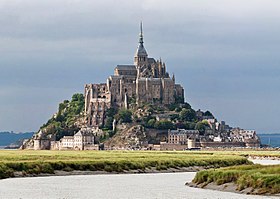
| Mont Saint Michel, Normandy, France |
- "The Archangel [Michael] stands for Church and State, and both militant." - Ch. 1 Saint Michiel de la Mer del Peril, 343
- "Church and State, Soul and Body, God and Man, are all one at Mont Saint Michel, and the business of all is to fight, each in his own way, or to stand guard for each other." - 349
- "The great cathedrals after 1200 show economy, and sometimes worse. The world grew cheap, as worlds must." - 350
- "Barring her family quarrels, Europe was a unity then [11th century], in thought, will and object. Christianity was the unit. Mont Saint Michel and Byzantium were near each other...The East was the common enemy, always superior in wealth and numbers, frequently in energy, and sometimes in thought and art." - Ch. 3 The Merveille, 371
- "History is only a catalogue of the forgotten. The eleventh century is no worse off than its neighbors. The twelfth is, in architecture, rather better off than the nineteenth." - 373
- "To overload the memory with dates is the vice of every schoolmaster and the passion of every second-rate scholar." - 374
- "Saint Francis was preaching to the birds in 1215 in Assissi, and the architect built this cloister [the Merveille] in 1226 at Mont Saint Michel. Both sermons were saturated with the feeling of the time, and both are about equally worth noting, if one aspires to feel the art." - 382
- "the Norman will be the practical scheme which states the facts, and stops; while the French will be the graceful one, which states the beauties and more or less fits the facts to suit them. Both styles are great: both can sometimes be tiresome." - Ch. 4 Normandy and the Ile de France, 392
- "In the western church the Virgin had always been highly honored, but it was not until the crusades that she began to overshadow the Trinity itself." - Ch. 6 The Virgin of Chartres, 427
- "Chartres represents, not the Trinity, but the identity of the Mother and Son. The Son represents the Trinity, which is thus absorbed in the Mother." - 436
- "The world still struggles for unity, but by different methods, weapons and thought." - Ch. 8 The Twelfth Century Glass, 470
- "Mary's taste was infallible; her knowledge like her power had no limits; she knew men's thoughts as well as acts, and could not be deceives...in the twelfth century the gallows was a trifle; the Queen hardly considered it a punishment for an offence to her dignity. The artist was vividly aware that Mary disposed of Hell." - Ch. 9 The Legendary Windows, 490
- "the sermon of Chartres...teaches and preaches and insists and reiterates and hammers into our torpid minds the moral that the art of the Virgin was not that of her artists but her own. We inevitably think of our tastes; they thought instinctively of hers." - Ch. 10 The Court of the Queen of Heaven, 519
- "The docile obedience of the man to the woman seemed as reasonable to the thirteenth century as the devotion of the woman to the man, not because she loved him, for there was no question of love, but because he was her man, and she owned him as though he were her child." - Ch. 11 The Three Queens, 533
- "it is the art we have chased through this French forest...and the art leads always to the woman." - Ch.12 Nicolette and Marion, 568
- "If a Unity exists, in which and towards which all energies centre, it must explain and include Duality, Diversity, Infinity, -- Sex!" - Ch. 13 Les Miracles de Notre Dame, 582-3
- "The People loved Mary because she tramples on conventions; not merely because she could do it, but because she liked to do what shocked every well-regulated authority." - 585
- "Mary concentrated in herself the whole rebellion of man against fate; the whole protest against divine law; the whole contempt for human law as its outcome; the whole unutterable fury of human nature beating itself against the walls of its prisonhouse" - 596
- "Army, Church, and State, each is an organic whole, complex beyond all possible addition of units, and not a Concept at all, but rather an animal that thinks, creates, devours and destroys." - Ch. 14 Abelard, 621
- "For several thousand years mankind has stared Infinity in the face without pretending to be the wiser; the pretention of Abelard was that, by his dialectic method, he could explain the Infinite, while all other theologists talked mere words" - 632
- "The [Church's] battle with the schools had then resulted only in creating three kinds of sceptics: the disbelievers in human reason; the passive agnostics; and the sceptics proper who would have been atheists had they dared." - Ch. 15 The Mystics, 639
- "If ever modern science achieves the definition of Energy, possibly it may borrow the figure: -- Energy is the inherent effort of every multiplicity to become unity." - 649
- "The charm of the twelfth-century Church was that it knew how to be illogical...when God himself became illogical." - 656
- "God is an intelligent, fixed Prime Motor, -- not a concept, or proved by concepts; -- a concrete fact, proved by the senses of sight and touch. On that foundation Thomas built." - Ch. 16 Saint Thomas Aquinas, 668-9
- "The whole universe is, so to speak, a simple emanation from God. The famous junction, then, is made! that celebrated fusion of the Universal with the Individual, of Unity and Multiplicity, of God and Nature, which had broken the neck of every philosophy ever invented" - 674
- "Theist or atheist, monist or anarchist must all admit that society and science are equally interested with theology in deciding whether the Universe is one or many, a harmony or a discord. The Church and State asserted that it was a harmony and that they were its representatives." - 682
Democracy, Esther, Mont Saint Michel and Chartres, The Education of Henry Adams by Henry Adams, Library of America, 1983.
Saturday, September 8, 2012
The Two Gentlemen of Verona by William Shakespeare
Characters
- Duke of Milan: Silvia's father
- Valentine: Gentleman of Verona
- Proteus: Gentleman of Verona
- Antonio: Proteus' father
- Thurio: foolish rival to Valentine
- Eglamour: Agent for Silvia in escape
- Host: where Julia lodges
- Outlaws: with Valentine
- Speed: a clownish servant to Valentine
- Launce: a clownish servant to Proteus
- Panthino: Servant to Antonio
- Julia: beloved of Proteus
- Silvia: beloved of Valentine
- Lucetta: waiting-woman to Julia
- After receiving no response from Julia to his letter of love, Proteus follows his friend Valentine to Milan and decides to begin pursuing the current love interest of Valentine, Silvia. By informing the Duke of Valentine's plan to run off with the Duke's daughter Silvia, Valentine is banished to Mantua, and Proteus continues in his pursuit. His abandoned love interest, Julia gets in close to the intrigue by dressing herself as a boy and delivering a message to Silvia and observing the results.
- Proteus. He [Valentine] after honour hunts, I after love: he leaves his friends to dignify them more; I leave myself, my friends and all, for love. (1.1)
- Proteus is sent by his father Antonio to serve in the emperor's court alongside Valentine, just as the relationship between Proteus and Julia is budding. (1.3)
- Proteus. O, how this spring of love resembleth the uncertain glory of an April day, which now shows all the beauty of the sun, and by and by a cloud takes all away. (1.3)
- Speed. If you lover here [Silvia], you cannot see her.
- Valentine. Why?
- Speed. Because Love is blind. (2.1)
- Proteus. I will forget that Julia is alive, remembering that my love to her is dead; and Valentine I'll hold an enemy, aiming at Silvia as a sweeter friend. (2.6).
- in regards to winning the heart of a 'lady of Verona',
- Duke. She did scorn a present that I sent her.
- Valentine. A woman sometimes scorns what best contents her. (3.1)
- First Outlaw. [on the frontiers of Mantua, between Milan and Verona]...you [Valentine] are beautified with goodly shape and by your own report a linguist and a man of such perfection as we do in our quality much want --
- Second Out. ...Are you content to be our general? To make a virtue of necessity and live, as we do, in this wilderness?...
- Valentine. I take your offer and will live with you, provided that you do no outrages on silly women or poor passengers.
- Third Out. No, we detest such vile base practices.
- Thurio. How likes she [Silvia] my discourse?
- Proteus. Ill, when you talk of war.
- Thurio. But well, when I discourse of love and peace?
- Julia. [In disguise; Aside] But better, indeed, when you hold your peace.
- Thurio. What says she to my valor?
- Proteus. O, sir, she makes no doubt of that.
- Julia. [Aside] She needs not, when she knows it cowardice.
- Thurio. What says she to my birth?
- Proteus. That you are well derived.
- Julia. [Aside] True; from a gentleman to a fool.
- Thurio. Considers she my possessions?
- Proteus. O, ay; and pities them.
- Thurio. Wherefore?
- Julia. [Aside] That such an ass should owe them.
- Proteus. That they are out by lease.
Friday, September 7, 2012
The Tempest by William Shakespeare
Characters
- Alonso: King of Naples
- Sebastian: Alonso's brother
- Prospero: the right Duke of Milan
- Antonio: Prospero's brother, the usurping Duke of Milan
- Ferdinand: Alonso's son
- Gonzalo: honest old Counsellor
- Adrian: Lord
- Francisco: Lord
- Caliban: savage and deformed Slave
- Trinculo: Jester
- Stephano: drunken Butler
- Miranda: Prospero's daughter
- Ariel: airy Spirit, among others (Iris, Ceres, Juno, etc.)
- As the King of Naples and his crew return home from the wedding of his daughter in Tunis, they are shipwrecked on an island by a spirit commanded by the Duke of Milan. The Duke has been on the island for 12 years along with his daughter, and his brother, the usurping Duke of Milan, washes ashore with the other members of the King's entourage. There is love. There is forgiveness.
Notes/Quotes
- Antonio [usurping Duke]. Let's all sink with the king.
- Sebastian [King's brother]. Let's take leave of him. (1.1)
- Prospero has been in an island gaol for 12 years (1.2)
- Miranda [Prospero's daughter]. I should sin to think but nobly of my grandmother: good wombs have borne bad sons. (1.2)
- Prospero enlisted Ariel's help in crashing the boat with the King's and his entourage and dispersing them safely on the island in exchange for the spirit's liberty (1.2)
- Sebastian. Thy case, dear friend, shall be my precedent; as thou got'st Milan, I'll come by Naples. Draw thy sword: one stroke shall free thee from the tribute which thou payest; and I the king shall love thee.
- Antonio. Draw together; and when I rear my hand, do you the like, to fall it on Gonzalo. (2.1)
- Trinculo [Jester]. Swum ashore, man, like a duck: I can swim like a duck, I'll be sworn. (2.2)
- Enter Prospero above, invisible. Enter several strange Shapes, bringing in a banquet; they dance about it with gently actions of salutation; and, inviting the King, et cetera, to eat, they depart (3.3)
- Ariel. But remember -- for that's my business to you -- that you three from Milan did supplant good Prospero; exposed unto the sea, which hath requit it, him and his innocent child: for which foul deed the powers, delaying, not forgetting, have incensed the seas and shores, yea, all the creatures, against your peace. (3.3)
- Miranda. These our actors, as I foretold you, were all spirits and are melted into air, into thin air: and, like the baseless fabric of this vision, the cloud-capp'd towers, the gorgeous palaces, the solemn temples, the great globe itself, yea, all which it inherit, shall dissolve and, like this insubstantial pageant faded, leave not a rack behind. We are such stuff as dreams are made on, and our little life is rounded with sleep. [emphasis mine] (4.1)
Sunday, August 19, 2012
Growth Fetish by Clive Hamilton
- Growth Fetishism
- The Growth Fetish - Ch. 1
- "In the thrall of the growth fetish, all the major political parties in the West have made themselves captives of the national accounts." - 2
- "Cargo cults and the growth fetish both invest magical powers in the properties of material goods, possession of which is believed to provide for a paradise on earth....each has prophets whose role is to persuade ordinary people to keep the faith, to believe that more cargo or more money will arrive and will take believers to a plane of ecstasy." - 4
- Economists on Wellbeing - Ch. 2
- John Stuart Mill, "the best state for human nature is that in which, while no one is poor, no one desires to be richer, nor has any reason to fear being thrust back by the efforts of others to push themselves forward." - 9
- fore neoliberal economists, "wellbeing is produced by pouring goods and services into a receptacle marked 'human being' -- as if people were production processes that convert commodities into happiness." - 12-13
- The Great Contradiction - Ch. 3
- "Americans believe that the value system that dominates their society is wrong" - 14
- "Americans believe that materialism has overtaken society, with dire consequences" - 14
- "Americans are ambivalent about the contradiction they face. They can see that materialism is corroding the society and themselves, but they are too fearful to change their behaviour in any significant way." - 14
- "Americans understand, albeit somewhat vaguely, that rampant consumerism is destroying the natural environment." - 15
- Political Implications - Ch. 4
- "The individual is not the citizen but the consumer, and for the consumer to be powerful everything must be brought into the realm of the market." - 17
- "Social democracy is being superseded by a sort of market totalitarianism." - 21
- Growth and Wellbeing
- Income - Ch. 5
- "with respect to income, people judge their wellbeing not by the absolute amount of their income but by its relative level." - 27-28
- "more income does make a difference to people who are very poor and lack the basics of food, shelter and health care. But this does not change the fundamental observation that in rich countries increasing income through more economic growth does not improve levels of national wellbeing." - 33
- Personal Happiness - Ch. 6
- "the more our media, advertisers and opinion makers emphasise financial success as the chief means to happiness the more they promote social pathologies." - 40
- "psychiatric disorders are frequently misdiagnosed and improperly treated as physical disorders because of the general social fixation on correcting deviations from a happy ideal rather than acknowledging widespread social distress." - 41
- Values and Meaning - Ch. 7
- "The purpose of life is not to be happy; it is to understand ourselves so that we can achieve personal integration or reconciliation with our selves. It is a process rather than a final state." - 48
- Karl Marx, "The bourgeoisie...has politically torn asunder the motley feudal ties that bound man to his 'natural superiors', and has left remaining no other nexus between man and man than naked self-interest, than callous 'cash payment'." - 52-53
- Alternative Measures - Ch. 8
- Genuine Progress Indicator (GPI): "incorporates a range of factors that influence wellbeing and aggregates them into a single index that can be compared directly over time with GDP." - 55
- "The economy spits out what it does not need -- redundant workers, toxic wastes -- and by this act they no longer appear in the national accounts...The economy values only what it needs; what it does not need has no value." - 60-61
- Identity
- Having and Wanting - Ch. 9
- "margin of discontent" (cf. Mishan) - difference between what you want and have; discontentment can be reduced by either increasing possessions or decreasing desires - 62
- "One of the ironies of the modern world is that choice has been elevated to supreme status precisely at a time of social and cultural homogenisation across the globe." - 66
- Consumption and the Modern Self - Ch. 10
- "in consumer society people attempt to create an identity not from what they produce but from what they consume." - 70
- "as the sociologist George Simmel told us many years ago, the individuality of modern urban life is a pseudo-individuality of exaggerated behaviours and contrived attitudes." - 71-72
- "We are subtly schooled to feel that to possess is to capture power; indeed, that possessions are the source of power in our society." - 75
- Marketing - Ch. 11
- "in reality economic growth can be sustained only as long as people remain discontented. Economic growth does not create happiness: unhappiness sustains economic growth." - 80
- "The expense associated with creating and sustaining a brand, including advertising and sponsorships, explains the cavernous gap between what it costs to actually manufacture a pair or shoes, for example, and the price the consumer pays." - 86
- Overconsumption - Ch. 12
- "Both the pharmaceutical and the food industries profit from obesity and, once again, the medical profession and drug companies play a crucial role in diverting us from asking what it is about our society that gives rise to these pathologies." - 94
- "There is...an intimate relationship between the creation of self in consumer capitalism and the destruction of the natural world. This is the unbridgeable gulf between the 'sustainability' that politicians and business people talk about and the deep ecology of the environmentalists." - 97
- Progress
- The Idea of Progress - Ch. 13
- "In developing the idea of progress, the intention was to find the impersonal laws that explained the sweep of human history." - 99
- Francis Fukuyama, "Technology makes possible the limitless accumulation of wealth, and thus the satisfaction of an ever-expanding set of human desires" - 103
- Oppression and Liberation - Ch. 14
- "Conservative resistance to the demand for self-determination conflates the pursuit of self-determination (individualisation) with the pursuit of selfish interests (individualism)." - 104-105
- "The democratic impulse -- which to date has taken the form of collective struggles to be free of autocrats, plutocrats and oligarchs -- has segued into something else, a search for authentic identity, for self-actualisation." - 106
- "the counter-culture was never a revolt against capitalism: it was a revolt against the social conservatism that held capitalism back." - 111
- Globalisation - Ch. 15
- "it is the spread of political ideas backed by economic power." - 118
- "while many nations achieve political independence after the Second World War, their leaders had absorbed the most intoxicating idea of their colonisers, the belief that the first objective of any state should be economic growth." - 119
- Politics
- The Third Way - Ch. 16
- "a means of grafting traditional social democratic concern for equality and social justice onto an economic system based on free markets." - 122
- "Nowhere in the writings of the Third Way can one find an analysis of how social structures condition thinking; nor can one find discussion of class consciousness or false consciousness or any inkling of why people believe what they do. The political superficiality of the Third Way is the ideal counterpart of the emptiness of modern consumer capitalism." - 130
- The Power of Economic Ideas - Ch. 17
- 1995: "US economists David Card and Alan Krueger created a sensation by showing that employment growth was higher in those US states that had rising minimum wages." - 136
- Power and Equality - Ch. 18
- "equality of opportunity can never be enough if an unacceptable level of inequality is built into the very structure of the capitalist economy." - 140
- "social justice has become individualised and divorced from the essential structure of capitalism at a time when capitalism has reached its most purified form." - 141-142
- Work
- Rethinking Work - Ch. 19
- "The arrival of the age of abundance for the first time provides the possibility of the liberation of work." - 151
- "in a post-scarcity world work can be liberated from the bonds of wage and salary payment, so that it can be considered a creative self-realising activity." - 153
- The New Labour Market - Ch. 20
- "purposeful work, rather than paid employment, provides the rewards people most crave." - 157
- "Abandoning the idea of a career is in fact a process of self-liberation, an act of taking control of your life. In a post-scarcity society, one can fail in one's career but succeed as a man or woman." - 164
- In Praise of Housework - Ch. 21
- "Because housework contributes to a warm, loving and nurturing home environment, we are mistaken to think of it merely as an activity that produces 'household goods and services'." - 167
- "The commodification of household work brings the value system of neoliberal economics into the realm where homo economicus is least welcome." - 169
- Work in a Post-Growth World - Ch. 22
- "An essential feature of a post-growth society, perhaps its defining feature, is the dissolution of the boundary between 'work' and 'life', so that work becomes life." - 171
- "It is the cultural rather than the economic power of capital that convinces them they must work longer and harder: they do so because of their belief about how much income they need in order to maintain an acceptable lifestyle and because income and job status remain central to social status. In other worlds, people have become habituated to high levels of income to sustain their sense of worth." - 173
- Environment
- The Voraciousness of Growth - Ch. 23
- The Conquering Spirit - Ch. 24
- Ecological Footprint: "for each person is defined as 'the biologically productive areas necessary to continually provide their resource supplies and absorb their wastes"; US - 10.3 hectares, UK - 5.2 hectares, Japan - 4.3 hectares, Germany - 5.3 hectares, China - 1.2 hectares, India - 0.8 hectares (Ecological Footprints of Nations, Wackernagel, 1997)
- "Commercial opportunity is the handmaiden of the conquering spirit latterly expressed in the invasion of space. Private sector investment in space-related activities is expanding enormously and is already giving rise to intense pressure for unfettered access to space for commercial purposes." - 189
- A Philosophical Transition - Ch. 25
- Instrumental Value Theory: "while humans are valuable in and of themselves, the non-human world is valuable only insofar as it contributes to the wellbeing of humans." - 191
- Instrumentalist attitudes to Nature
- "the environment is valuable to humans because physical resources provide economic value." - 192
- "preoccupied with the physical transformation of resources but recognises the physical limits to material growth." - 192
- "instrumental value can be had from preserving rather than exploiting some aspects of the natural environment." - 193
- Intrinsic Value Theory: "Environmentalism begins from an intuitive rejection of all instrumentalist approaches...the value of the environment is not dependent on humans attaching value to it, and certainly not on humans deciding whether it contributes to their economic welfare." - 194
- "the marketplace is intensely impersonal, a place where actions are motivated by self-interested calculation between distinct individuals. It allows the full expression of instrumentalist desire." - 196
- Environmentalism and Social Democracy - Ch. 26
- "Proposals that would see higher taxes on environmentally damaging activities, with the revenue used to reduce taxes on employment and investment, are known under the rubric of ecological tax reform." - 200
- Environmental Koznets Curve: "as poor countries industrialise environmental quality will initially deteriorate but as they become richer they will express a greater 'preference' for environmental quality" - 202
- The Post-Growth Society
- Political Downshifting - Ch. 27
- Eudemonism: The Politics of Happiness - Ch. 28
- "It reaffirms a necessary role for public ownership, but it does not propose any expropriation of private property. It is, however, anti-capitalist in the sense that it argues that society and governments should no longer cede special significance to the objectives or moral claims of the owners of capital." - 212-213
- "the function of the government will be reoriented so that it provides sustenance to life-affirming activities outside the market." - 215-216
- Starting the Transition - Ch. 29
- "Reduction of working hours is the core demand for the transition to a post-growth society." - 218
- "The transition to a post-growth society would begin by imposing restrictions on the quantity and nature of marketing messages" - 219
- "Short-term speculative capital movements should be severely penalised by an international transactions tax." - 220
- "A recasting of tax systems...would supply the revenue for a basic income to be provided unconditionally to all citizens." - 222
- The Post-Growth Economy - Ch. 30
- J. M. Keynes, "for the first time since his creation man will be faces with his real, his permanent problem -- how to use his freedom from pressing economic cares, how to occupy the leisure, which science and compound interest will have won for him, to live wisely and agreeably and well" - 225
- "In the longer term, stabilising population size will reduce the pressure to create new jobs each year so as to absorb new entrants to the labour market." - 228
- "It is erroneous to believe that humans became creative only in response to financial incentives." - 232
- Power and Social Structures - Ch. 31
- "The deprivation model is simply the obverse of the growth model; they are both preoccupied with more income." - 233
- "Whatever the merits of the trickle-down theory in poor countries, it certainly stops working beyond a certain point in rich countries." - 235
- "Whereas Marxism called for the power of capital to be destroyed, eudemonism calls for it be ignored." - 237
Subscribe to:
Posts (Atom)